
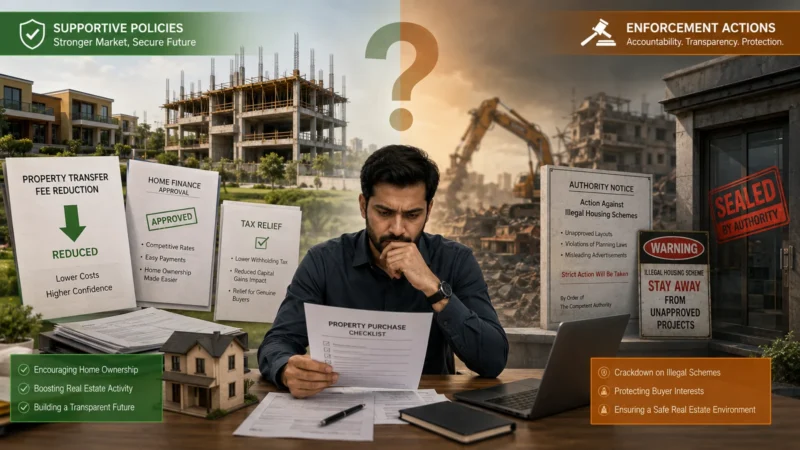
Pakistan’s real estate market is passing through a difficult and confusing phase. Construction costs remain high, buyer affordability is weak, taxation has affected transaction activity, and many investors are already cautious. In this environment, the government and development authorities are sending two different signals to the property market.
On one side, there are steps that appear supportive for real estate. Housing finance is being promoted, property transaction costs are being reviewed, court and policy developments are giving some relief to property owners, and public messaging suggests that investment and construction activity should be encouraged. These steps are important because Pakistan needs housing, construction jobs, documented transactions, and investor confidence.
On the other side, there is a growing wave of enforcement activity. CDA and RDA have been publishing lists of illegal or unapproved housing schemes, issuing public warnings, sealing offices, serving notices, and carrying out anti-encroachment or demolition operations in different parts of Islamabad and Rawalpindi.
This creates a serious confidence problem. The market hears that property investment should be encouraged, but at the same time, it also sees enforcement news, illegal scheme lists, sealing actions, and public notices. For genuine buyers and investors, this creates confusion: is the real estate sector being facilitated, or is it being pushed into deeper uncertainty?
Buyer Takeaway: Support Is Positive, But Legal Clarity Comes First
The important takeaway for buyers is simple. Lower transfer fees, housing finance support, possible tax relief, and legal relief around certain property taxes are positive for Pakistan’s real estate market, but they do not remove the need for legal verification. In 2026, genuine buyers should prefer approved, developed and legally clear property over speculative files, unclear extensions or schemes where approval status is doubtful.
The market does not fear regulation itself. Buyers fear uncertainty. If the government wants real estate investment to recover, supportive policy and strict enforcement must move together with clear public classification, buyer protection and practical regularization where possible.
The Real Issue Is Not Regulation
There should be no doubt that regulation is necessary. No serious buyer, investor, consultant, or real estate platform should support fake societies, illegal file selling, misleading marketing, or schemes launched without proper land ownership and approval.
A healthy real estate market needs approved layouts, valid NOCs, legal access roads, proper transfer systems, amenity areas, parks, utilities, and clear records. Without this, the public is exposed to fraud, uncertainty, and long-term losses.
But the real issue in Pakistan is not regulation itself. The real issue is delayed, unclear, and uneven regulation. When a scheme is newly launched without approval, quick action can protect people from future losses. But when an old area has existed for years, when people have already built homes, opened shops, installed utilities, and invested life savings, the matter becomes much more complicated.
In such cases, enforcement cannot be treated like a fresh violation that appeared yesterday. It becomes a public protection issue, a planning issue, and a confidence issue.
Why Delayed Enforcement Damages Confidence

When authorities publish long lists of illegal or unapproved schemes after many years, the public naturally asks an important question: if these schemes were illegal, why were they allowed to sell, advertise, develop, and expand for so long?
This question does not mean that illegal development should be ignored. It simply means that delayed enforcement creates public cost. Buyers may have purchased plots in good faith. Families may have built houses. Small businesses may have opened in those areas. Local property markets may have formed around those communities.
When action comes after years of silence, the burden often falls on ordinary people more than on the original decision-makers, developers, promoters, or institutions that allowed the situation to grow.
This is why the process needs to be careful, transparent, and structured. Sudden notices, sealing actions, demolition news, and repeated warnings may appear strong administratively, but they can disturb the wider market if there is no clear solution attached.
CDA Transfer Fee Reduction Is Positive, But Confidence Needs More Than Lower Fees
CDA’s decision to reduce property transfer charges is a positive step for Islamabad’s real estate market. High transfer costs make transactions difficult, especially when the market is already slow. Lower transaction cost can help genuine buyers and sellers complete deals through proper legal channels.
This is good for market liquidity. It can encourage documented transactions and reduce the pressure on buyers who are already dealing with taxes, construction costs, weak affordability and uncertain market conditions.
Our Review
This is a good policy direction, but it is not enough on its own. A buyer does not only look at transfer fee. A buyer also asks whether the property is legally safe, whether the project is approved, whether the transfer is secure, whether the area has future risk, and whether the investment can be defended legally.
If transfer costs are reduced but the market is simultaneously seeing enforcement news and uncertainty around housing schemes, the confidence benefit becomes limited.
Lower fees can improve market activity, but legal clarity protects confidence. Both are needed together.
Housing Finance Support Is Useful, But It Needs Legally Clear Inventory
Government-backed housing finance and low-cost home loan programmes can support genuine end-users. Pakistan has a major housing shortage, and many families cannot buy homes without long-term financing.
If properly implemented, housing finance can support construction, labour, cement, steel, finishing material, small contractors, and many connected industries. It can also help families move from rent to ownership.
For end-users, programmes like the Wazir-e-Azam Apna Ghar Program and the 1 Crore Mera Ghar Mera Ashiana home loan scheme can be useful, but only when the financed property is legally clear, bank-acceptable and properly documented.
Our Review
Housing finance is positive, but it works only when the property is legally clear. Banks, buyers, and investors need approved projects, reliable ownership records, safe transfer systems, and proper documentation.
If large numbers of housing schemes are publicly listed as illegal or unapproved, then buyers become unsure about where to safely invest. Banks also become cautious because legally unclear property is difficult to finance.
This creates a practical contradiction. The government wants people to buy homes, but many buyers are unsure which projects are legally safe. To make housing finance successful, authorities should also provide a simple and reliable public verification system for housing schemes.
Overseas Investment Packages Need Trust on the Ground
The government has also been discussing special real estate investment facilitation for overseas Pakistanis. This is a positive direction because overseas Pakistanis can bring formal foreign exchange, documented payments and long-term capital into Pakistan’s property market.
Manahil Estate has already covered the proposed real estate investment package for overseas Pakistanis, which shows that policymakers understand the importance of overseas capital. But incentives alone cannot rebuild trust if buyers fear illegal schemes, unclear approvals, weak project status or delayed enforcement.
Overseas investors are more sensitive to uncertainty because they cannot visit sites regularly, verify every notice personally, or follow local authority actions on ground. If the market is full of illegal scheme lists, unclear approval stages and delayed enforcement, overseas Pakistanis hesitate even when tax or investment incentives are offered.
For overseas capital to return seriously, Pakistan needs more than incentives. It needs a reliable verification system, safe banking channels, approved inventory, transparent project status and clear protection for genuine buyers.
Property Tax Relief Can Help, But Fear Cannot Be Removed by Tax Cuts Alone
There has also been discussion around possible relief for the property sector, including tax rationalization and lower transaction pressure. This is important because high taxation has slowed down real estate activity in recent years.
Recent Budget 2026-27 discussions have created a positive signal for the property sector. Reported proposals include a possible reduction in withholding tax on property purchase and sale, including relief under Sections 236K and 236C for filers. If implemented properly, this can reduce transaction pressure and encourage documented buying and selling.
Manahil Estate has discussed these real estate tax relief proposals for Budget 2026-27 in detail. The same subject is also important for buyers who want to understand practical transaction costs under FBR 236C and 236K property tax rules.
When taxes are too high, many people delay buying, avoid selling, or move their money to other areas. Rational taxes can bring activity back into the market and encourage proper documentation.
Before finalizing a transaction, buyers should also estimate taxes, DC value impact and transfer cost through a reliable property tax calculator with FBR and DC values, because affordability is not only about the sale price.
Our Review
Tax relief is useful, but it cannot solve the full confidence problem. If a buyer fears that a scheme may later face notices, sealing, litigation, or approval issues, lower tax will not be enough.
The real estate market needs a combined solution: reasonable taxes, strict action against fresh fraud, clear approval status, and fair regularization procedures for older populated areas where public money is already involved.
Section 7E Relief Also Supports Market Sentiment
Another important confidence signal is the recent court development around Section 7E property tax. Manahil Estate has reported that the Federal Constitutional Court scrapped Section 7E property tax on real estate, which had created concern among many property owners and investors because it increased the perception of tax pressure on immovable property.
For documented investors, this kind of relief can improve sentiment because tax clarity is an important part of long-term property planning. When investors feel that tax pressure is being rationalized, they become more willing to hold, buy, sell and document transactions.
But again, tax clarity is only one side of the market. The buyer also needs legal clarity, approval status, secure transfer, and protection from future enforcement uncertainty.
RDA’s Illegal Scheme Warnings: Necessary, But Classification Is Missing
RDA has warned the public against a large number of unauthorized or illegal private housing schemes in Rawalpindi-controlled areas. Such warnings are important because many people invest after seeing advertisements, dealer claims, social media campaigns, and attractive installment plans.
Public warnings can protect new buyers from risky investments. They also put pressure on developers who market projects before completing legal approvals.
Recent RDA action against 293 illegal housing societies in the Rawalpindi region shows that this is not a minor administrative issue. The authority’s crackdown, warnings and proposed legal actions are important for buyer protection, but the market also needs proper classification so genuine buyers can understand whether a scheme is fraud-risk, approval-pending, partially compliant, old populated, or completely non-regularizable.
Buyers should also compare any Rawalpindi project against reliable references such as the RDA approved housing schemes in Rawalpindi and the RDA illegal housing schemes list before making any payment.
Our Review
The warning itself is necessary, but a long list without proper classification is not enough. Every scheme is not the same. Some may have serious land ownership issues. Some may be selling files without control over land. Some may have submitted approval documents but not completed the process. Some may be old populated pockets where regularization may be possible with penalties and planning corrections.
A newly launched speculative file-selling project should not be treated the same way as an old area where people have already built homes and communities.
RDA should ideally classify schemes into clear categories: fraud-risk schemes, land-dispute schemes, approval-pending schemes, partially compliant schemes, old populated schemes, and non-regularizable schemes. This would help buyers understand the actual level of risk instead of only seeing a long fear-based list.
CDA’s Illegal Housing Scheme Lists: Buyer Awareness Is Good, But Resolution Is More Important
CDA has also updated public lists of illegal or unapproved housing and agro-farming schemes in Islamabad. These lists are useful for buyers who want to check whether a project has proper approval.
Recent CDA action in Islamabad Zones 3 and 4 also shows why buyers need exact status clarity. Many projects are marketed through attractive names, farmhouse concepts or installment plans, but the buyer must check whether the scheme is legally approved, whether the advertised block is covered, and whether development is allowed under the relevant planning rules.
Manahil Estate has covered CDA’s latest action against illegal housing and agro-farming schemes, and buyers should also review updated guidance on CDA illegal housing schemes in Islamabad before investing in private societies, agro-farming schemes or extension blocks.
However, the market needs more than names. Buyers need to know what the issue actually is. Is the scheme completely fake? Is the land ownership disputed? Is the NOC pending? Is the layout unapproved? Is the scheme partly developed? Are existing residents protected? Is regularization possible?
Our Review
Public lists should not only warn people; they should also guide them. Repeated lists without a clear resolution plan create confusion and fear.
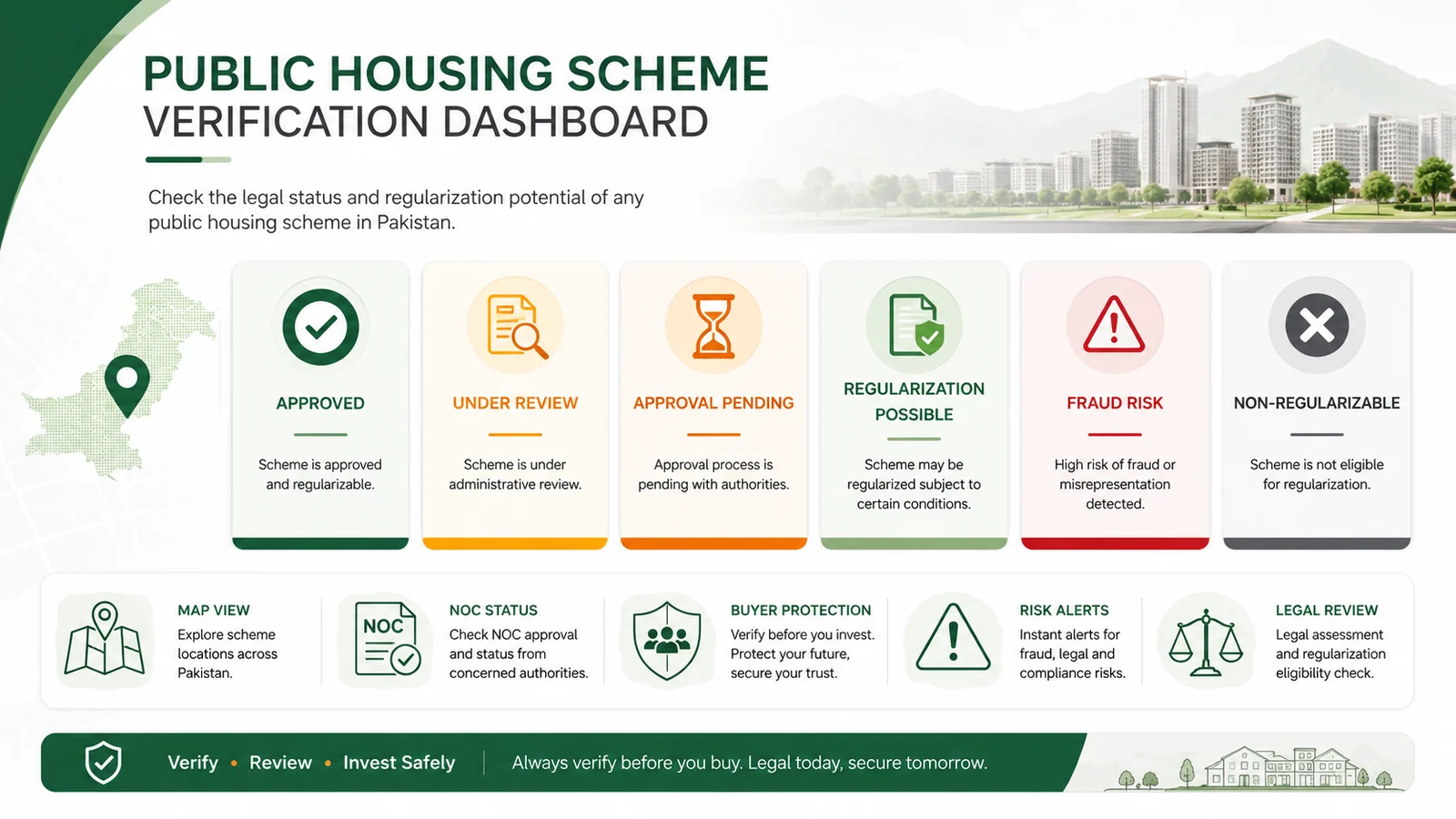
A better system would be a live public dashboard where every scheme has a clear status: approved, under review, approval pending, regularization possible, litigation pending, non-regularizable, or fraud-risk.
This would help genuine buyers, dealers, residents, overseas Pakistanis, and consultants make informed decisions. It would also reduce rumours because people would not have to depend only on market talk or incomplete social media posts.
Sealing of Scheme Offices: Valid for Fresh Sales, But Existing Buyers Need Protection
When authorities seal offices or stop public dealing in unapproved schemes, the stated purpose is usually to prevent further illegal sale and purchase. From a buyer protection point of view, stopping fresh sale in a legally unclear project can be justified.
If a project does not have approval and is still actively selling plots, action against fresh marketing can protect future buyers from taking risk unknowingly.
Our Review
The problem starts when old or semi-populated areas are handled with the same blunt approach. Sealing an office may stop new sales, but it does not solve the problem of existing buyers, built homes, local businesses, and families already living there.
For such cases, the better approach should be: freeze fresh sale first, stop misleading advertisement, collect records, verify land ownership, evaluate development, check public amenities, and then decide whether the scheme can be regularized, partially regularized, penalized, re-planned, or closed.
Existing buyers should not be left helpless between developers and authorities. Public protection should be part of the enforcement process.
Big-Name Notices Create Wider Market Anxiety
When notices or compliance issues involve large and well-known developers, the impact is not limited to one project. It affects the whole market mood. Ordinary investors start asking: if big names can face approval or compliance issues, what about smaller societies?
This does not mean large developers should be exempt from rules. In fact, large developers should follow rules more carefully because public exposure is much higher. Issues related to layout changes, amenity areas, NOC conditions, access roads, land use, and development boundaries must be addressed properly.
Our Review
Action against big developers should be transparent and specific. Authorities should clearly explain whether the issue affects the whole project, one phase, one block, an amenity area, an access road, future extension, or only a compliance condition.
Without this clarity, market rumours become stronger than official information. Buyers become confused, dealers start giving mixed explanations, and investor confidence weakens.
Large projects should be pushed toward compliance, but existing buyers should not become collateral damage in disputes between developers and authorities.
Old Settlements Are a Planning and Housing Policy Issue
Anti-encroachment operations in old settlements are among the most sensitive issues in Islamabad and Rawalpindi. Authorities may have legal reasons to recover state land, clear roads, protect nullahs, restore parks, or remove illegal structures from public land.
But old settlements are not always the same as new encroachments. Many families may have lived in such areas for years. Some areas may have informal records, utility connections, political history, local markets, schools, mosques, and established communities.
Our Review
Fresh encroachment and old habitation should not be treated in the same way. Fresh encroachment can be stopped quickly. Old populated settlements need surveys, hearings, verification, rehabilitation planning, and a humane process.
Where regularization is possible, it should be considered with planning corrections and reasonable penalties. Where relocation is necessary, there should be a clear resettlement plan. Where developer fraud is involved, recovery should be made from responsible parties before ordinary buyers suffer.
Urban planning cannot be fixed only with bulldozers. It needs policy, records, surveys, affordable housing options, and long-term governance.
The Perception of Uneven Enforcement Is Also a Market Problem
One of the biggest concerns in the property market is the perception that enforcement is not always equal or predictable. Whether this perception is fully accurate or not, it affects investor confidence.
When small settlements face quick action, old rural pockets face pressure, and large schemes remain stuck in notices and negotiations for years, people start questioning consistency. A strict system can still attract investment if it is clear and equal. An unpredictable system creates fear.
Our Review
The market does not fear regulation as much as it fears uncertainty. Investors can adjust to strict rules. They can verify approvals, pay legal costs, and avoid risky projects. But they cannot plan confidently when enforcement appears sudden, delayed, or selective.
Authorities should therefore focus on transparent process. Public notices should explain the issue, the category of violation, the next step, the rights of existing buyers, and whether regularization is possible.
This would make enforcement more credible and less damaging to market sentiment.
What Authorities Should Do Differently
The solution is not to ignore illegal schemes. That would be unfair to genuine buyers and approved developers. The solution is also not to treat every old populated area like a fresh illegal launch.
A better approach would be to create joint review committees for old, disputed, populated, or partially developed schemes. These committees should include the development authority, revenue department, planning experts, local administration, legal representatives, and buyer or resident representatives.
The committee should check land ownership, layout status, physical development, population, road access, utility status, public amenities, developer records, buyer records, and regularization possibility.
After review, every scheme should be placed into a clear category.
Approved or approvable with minor corrections: These schemes should be regularized through penalties, planning correction, amenity transfer, and development conditions.
Partially regularizable schemes: These may require re-planning, removal of specific violations, correction of amenity areas, or developer penalties while protecting existing genuine buyers as much as possible.
Non-regularizable but populated schemes: These should require a public protection plan before closure, including relocation or compensation where legally and practically justified.
Fraud-risk or file-selling schemes: These should face strict action, transaction freeze, recovery from sponsors, and buyer refund mechanisms.
This type of classification would be much better than repeated public lists that warn people but do not clearly solve the problem.
This is why a digital verification system is no longer optional. NAB’s Digital One-Click system for real estate fraud prevention is relevant because buyers need one place where they can check approval status, land backing, developer record, complaints, litigation, and fraud alerts before making payment. If such a system is implemented properly, it can reduce reliance on dealer claims, screenshots, social media marketing and incomplete market rumours.
What Buyers Should Do in 2026
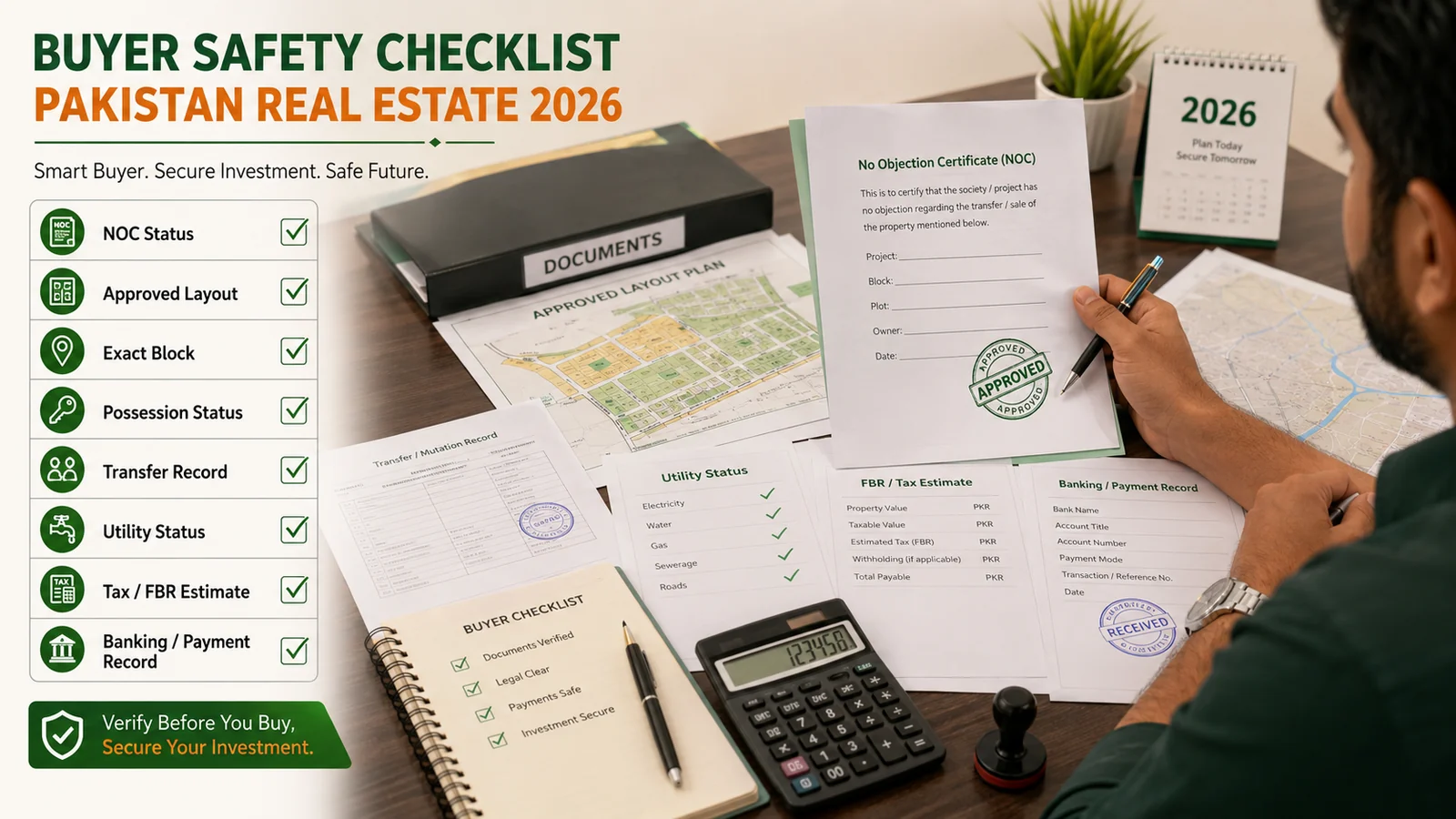
For buyers and investors, the lesson is clear. In 2026, legal verification is more important than ever. A low price, famous dealer, attractive installment plan, or strong marketing campaign is not enough.
Before buying, always verify the NOC status from the relevant authority. Check whether the layout plan is approved. Confirm whether the specific block, phase, or extension is included in the approval. Check whether possession exists. Confirm whether development is available on ground. Verify whether utilities are legally available. Also check whether transfer is being done through a proper documented system.
Buyers should also use official and reliable reference resources before making a decision. For Islamabad, check updated information on CDA illegal housing schemes in Islamabad. For Rawalpindi, compare the project against RDA approved housing schemes in Rawalpindi and the RDA illegal housing schemes list. A project that is cheap but legally unclear can become expensive later if transfer, possession or resale becomes difficult.
Buyers should be careful with common market phrases such as “NOC under process,” “approval expected soon,” “society is old so it is safe,” or “everyone is buying here.” These statements may be common in the market, but they are not legal proof.
In the current environment, developed and approved areas with clear transfer systems are more valuable than speculative discounted files. Legal clarity is now one of the strongest features of any property investment.
Final Analysis
Pakistan’s real estate market does not need lawlessness. It needs clean, documented, approved, and transparent development. Fake societies, illegal file selling, misleading advertisements, and unapproved land development have damaged the market for years.
At the same time, authorities must also recognize that delayed enforcement creates public cost. If a scheme has existed for many years, if homes have been built, if shops are operating, if families are living there, and if public money has already been invested, then the response should be more careful than a simple notice or sudden operation.
The state has the right to regulate land. But regulation should come with procedure, transparency, classification, regularization options, buyer protection, and fair recovery mechanisms.
This is why Pakistan’s real estate sector in 2026 is facing a confidence crisis. The government is trying to support investment through housing finance, fee reductions, possible tax relief, overseas investment facilitation and property-tax relief through court developments. But frequent enforcement news, illegal scheme lists, notices, sealing actions, and demolition operations are making investors more cautious.
The way forward is not silence and not panic. The way forward is structured reform.
Manahil Estate’s view is simple: legal and approved real estate should be promoted strongly. Fraud and fake schemes should face strict action. But old populated schemes and long-standing settlements should go through proper review, classification, regularization where possible, and buyer protection before harsh enforcement. This balanced approach can protect the public, improve legal discipline, and rebuild investor confidence in Pakistan’s property market.