Bahria Town Phase 8 Rawalpindi has been in the news for quite some time for its alleged illegal developments, land disputes and development delays. Recent developments have created considerable panic and restlessness among the investors and allottees of Bahria Town, while the society itself has failed to clearly explain the actions being taken by different authorities against lands claimed, developed and sold by Bahria Town Private Limited.
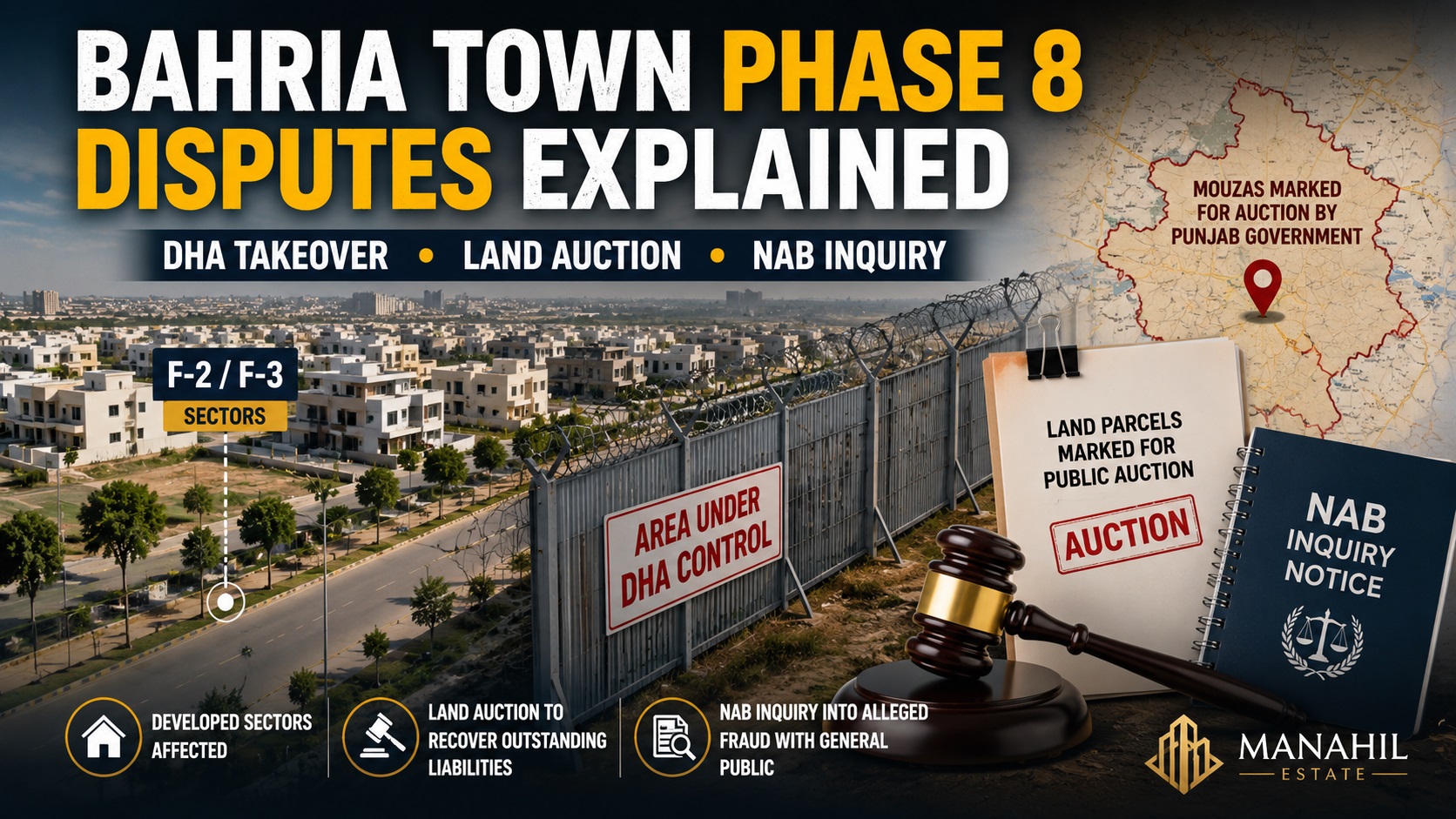
There are three distinct issues going on side by side in Bahria Town Phase 8 Rawalpindi:
- DHA has physically taken control of parts of Sector F-2 and Sector F-3 and erected fences within these sectors to mark the area under its control.
- The Government has marked specific land parcels situated in certain mouzas associated with Bahria Town Phase 8 and its extensions for public auction in order to recover outstanding liabilities from Bahria Town Private Limited and its owners.
- NAB has initiated an inquiry into alleged fraud with the general public in Bahria Town Phase 8 Extension.
These three issues are related to Bahria Town but they are separate proceedings involving different authorities, different lands and different categories of members. The DHA occupation concerns developed plots and constructed houses in parts of F-2 and F-3, the Government auction concerns specific land parcels situated in several revenue estates, while the NAB inquiry mainly concerns members of Phase 8 Extension who paid for plots but have not received possession despite waiting for many years.
We will explain each of the above issues separately so that our readers can understand what actually is going on, what the official position of Bahria Town is, and what actions are being taken by the affectees and Bahria Town Private Limited against these issues. Moreover, we will discuss DHA’s position on the takeover and what DHA representatives are reportedly conveying to the affected members.
It is important to clarify at the outset that physical fencing in F-2 and F-3 is visible, while the NAB notice and Government auction notices are documented developments. However, DHA has not yet issued any official public policy for the affected members. Similarly, no official adjustment plan, additional charges, recognition of Bahria Town allotment letters or final outcome of the legal proceedings has been announced so far.
DHA Takeover of Sectors F-2/F-3
This is the major visible development which created a lot of confusion and panic in the market. Since the land occupied by DHA comprises plots and houses sold by Bahria Town to the general public, this has become a major case of third-party interest.
The physical occupation and fencing do not by themselves explain the final legal ownership of the land, the exact terms of DHA’s claim or what will happen to the existing allottees. These matters will depend on the ownership record, earlier agreements between DHA and Bahria Town, court proceedings and any policy announced by the two housing authorities.
Bahria Town currently seems reluctant to forego this land, hence it has reportedly filed a petition before the relevant court in Rawalpindi against this takeover by DHA. Bahria Town is also contacting members of these sectors whose plots fall within the occupied area to become part of the petition and authorise Bahria Town to fight the case on the ground of third-party interest on behalf of the members.
Members should carefully read any authority letter, undertaking or power of attorney before signing it and should retain a complete copy for their own record. Supporting the legal case may be necessary for protecting their ownership claims, but members should clearly understand what powers they are giving to Bahria Town and what relief is being requested from the court.
Bahria Town and the members are hopeful that the court will safeguard the interests of the allottees and that their ownership will remain protected regardless of who ultimately controls this area. However, any interim stay order may only stop further action or maintain the existing position until the case is decided. It does not necessarily mean that the fences will immediately be removed or that final ownership has been decided in favour of either party.
DHA has not yet recognised the affected Bahria Town allottees or formally accepted responsibility for their ownership claims. Members who approach DHA for clarification are reportedly directed back to Bahria Town on the ground that they paid money to Bahria Town and received their allotment letters from Bahria Town.
It is important to mention here that no official clarification or detailed justification of this occupation has been released by DHA till date. Until an official public statement is issued, members are still hoping that DHA may finally announce a policy to accept or adjust the affected allottees if it intends to retain control of the occupied land.
Bahria Town’s Stance
Bahria Town Private Limited appears baffled by this development and has not provided any satisfactory answers to the affected members.
The financial and land-related issues between DHA and Bahria Town are long-standing, and Bahria Town was well aware of the possible repercussions of failing to resolve those issues. If the occupied land was already subject to an earlier agreement, settlement, financial claim or ownership dispute with DHA, Bahria Town must explain why plots were sold and houses were allowed to be constructed without fully resolving the underlying matter.
No detailed statement from the owners of Bahria Town, including Malik Riaz or Ali Riaz Malik, has been issued so far. However, some announcements, letters and notices were issued by Bahria Town Head Office which were mainly meant to show that Bahria Town did not know anything about this takeover beforehand and that, according to its own position, Bahria Town owes nothing to DHA in relation to the occupied land.
Bahria Town seeks the support of members and asks them to join its legal cases against the Punjab Government, NAB and DHA. By bringing the public and existing allottees into its ongoing legal battles, Bahria Town intends to fight these cases on the ground of third-party interest.
Third-party interest is certainly an important legal issue because the affected plots were not vacant lands lying only between two companies. They were sold to members, transferred through Bahria Town’s own system, and in some cases houses were constructed after approvals and payments to Bahria Town.
However, Bahria Town must do more than simply ask members to become part of its legal cases. It must provide the exact affected area, plot numbers, ownership record, details of previous agreements with DHA, copies of court petitions and a written plan explaining what it will do if it fails to retain the disputed land.
In our assessment, Bahria Town has so far failed to demonstrate either a clear policy or an effective mechanism for resolving the members’ concerns.
DHA’s Position and What Members Are Being Told
While no official public statement has been issued by DHA till date, DHA representatives reportedly say that DHA owns the subject land and has taken physical control of it.
There are rumours that DHA may ultimately announce an official policy to facilitate the affected members. Such a policy may involve recognition or adjustment of existing plots against additional membership, development, conversion or administrative charges.
There are numerous figures and rumours about additional charges circulating in the market, but there is nothing official as yet. Members should not pay anyone or make decisions on the basis of unofficial charge calculations, dealer claims or unverified social-media messages.
Some members claim that DHA senior officials have clearly told them that the affected members belong to Bahria Town because they paid money to Bahria Town and received allotments from Bahria Town, so DHA currently has nothing to offer them.
These are unofficial statements reportedly narrated by members and affectees after visiting DHA offices. They should not be treated as DHA’s final policy unless the same position is issued through an official notice, letter or public announcement.
At present, these accounts indicate that DHA may not immediately accept or facilitate the affected members of the occupied plots in F-2 and F-3. At the same time, it is also possible that DHA is waiting for completion of the demarcation, legal proceedings or settlement before announcing any public policy.
Possible Outcomes
There are several potential outcomes from this entire situation.
1. Interim Protection from the Court
Bahria Town may obtain a stay or status quo order from the court on the ground of third-party interest. Such an order may stop further occupation, construction, transfer or alteration of the disputed land until the case is finally decided.
However, removal of the existing fences will depend on the exact wording of the court order. A stay order does not automatically mean that the fences will be removed.
2. Bahria Town Retains the Land
Bahria Town may succeed in proving its ownership or resolving the dispute with DHA, allowing the existing allotments and ownership documents to remain unchanged.
This appears to be the outcome Bahria Town and the affected members are currently seeking through the court.
3. Alternative Plots from Bahria Town
Bahria Town may have to surrender ownership or control of the occupied area and offer alternative plots to the affected members in some other sectors.
However, members may be reluctant to accept undeveloped or less valuable alternative plots against their developed and possession plots in F-2 or F-3. Any adjustment policy would therefore need to consider location, development status, plot category, market value and construction already made on the land.
4. DHA Recognises Existing Members
DHA may announce a policy to recognise or adjust the affected members against membership, development, conversion or other charges.
This may be acceptable to many members if their original plot locations, sizes and ownership rights are protected. However, no such policy or charge structure has been officially announced so far.
5. Negotiated Settlement Between DHA and Bahria Town
DHA and Bahria Town may reach a settlement under which control of the land is transferred or adjusted while existing houses and plots are protected.
Such a settlement would be the most practical outcome for members, but it will require both parties to recognise the third-party interests already created over the land.
6. Prolonged Litigation
The dispute may remain pending before the courts for a long period without any immediate final policy. During this period, transfers, construction, possession and market activity in the affected area may remain uncertain.
Members are reluctant to trust Bahria Town due to its history of false promises, poor management and legal complications. Bahria Town is trying to manage the situation but it does not currently appear to have the capacity or the will to properly address the concerns.
At present, many affected members see supporting Bahria Town’s legal position as the only practical option, especially when no alternative solution has been offered. If DHA assures members that their ownership will be accepted and protected, almost all members of F-2 and F-3 may happily opt for DHA allotments because the security of their assets is their primary concern.
Land Auction by the Punjab Government
The Government of Punjab, through the Assistant Commissioner Rawalpindi, has marked specific land parcels in several mouzas of Rawalpindi where lands are reportedly owned by or linked with Ali Riaz Malik and Bahria Town.
Those mouzas include Sohawa, Lari Malana, Thatha Gadhpur, Mohra Lagial, Sangral and Bagh, among others, where specific land parcels have reportedly been marked for public auction for recovery of outstanding liabilities from Bahria Town Private Limited and its owners.
It is important to understand that the naming of a mouza in an auction notice does not necessarily mean that the entire mouza or every plot situated within it is being auctioned. A mouza is a large revenue estate which may contain land belonging to several different owners.
The exact position can only be determined by matching the khasra numbers, ownership entries and land measurements mentioned in the auction notice with the approved or marketed maps of Bahria Town.
If you look at the district council and available revenue maps for these mouzas, the mentioned areas appear to cover or overlap several non-developed or semi-developed sectors associated with Bahria Town Phase 8, including Phase 8 Extension, Bahria Orchard, F-4, F-5, E-1 Extension, J-1 and K-1.
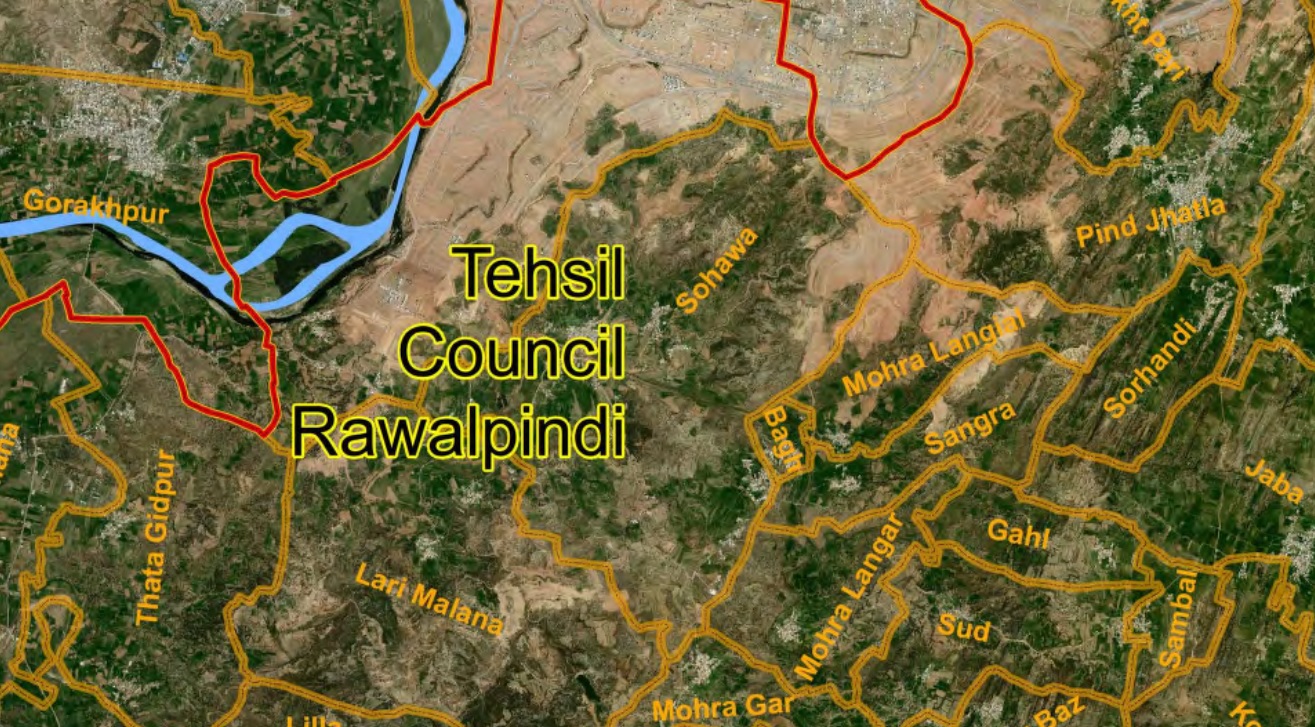
However, a general map comparison alone cannot conclusively establish that every plot or complete sector falls within the auctioned land. Bahria Town, the Assistant Commissioner and the relevant revenue authorities must publish the exact khasra numbers and a proper demarcation showing which sold plots and sectors are affected.
The subject sectors have already been sold to the general public, while there is little development on the ground in several of these areas. Unless there is clarification from the Government regarding whether the sold-out plots and sectors form part of the auction proceedings, there will remain grave uncertainty about the future of these sectors and their respective members and plot owners.
Reportedly, auction proceedings involving approximately 1,000 kanals of land located in or associated with Bahria Town Phase 8 Extension were held on 17 June 2026. However, clear official information regarding the exact auctioned khasra numbers, successful bidders, final sale value and transfer of possession has not yet been made publicly available.
There is an important difference between land being marked for auction, an auction being scheduled, bids being received and an auction being successfully concluded. Until the official result is available, members should not assume that every marked parcel has already been finally sold and transferred to another party.
No clear information about the other marked mouzas and sectors is currently available, so members of those sectors remain uncertain about their future situation.
Bahria Town has also reportedly filed a petition against NAB and the Punjab Government on the ground that the subject lands have already been sold to the general public and therefore involve serious third-party interests.
Once again, Bahria Town must provide the affected members with exact land details instead of issuing only general letters asking for public support. Members need to know whether their plot number and street actually fall within the land mentioned in the auction notice.
Earlier RDA Inquiry into Phase 8 Complaints
The current developments have not appeared suddenly. Members of Bahria Town Phase 8 and its extensions have been complaining about delayed possession, additional payment demands, regulatory issues and lack of development for many years.
In January 2026, the Rawalpindi Development Authority ordered an inquiry into complaints relating to Bahria Town Phase 8 after affected allottees raised issues regarding prolonged delays in possession and other demands by the society.
This earlier action shows that the NAB inquiry is not an isolated development. It is part of a wider problem involving plots sold to the public without timely possession, development or clear regulatory protection.
NAB Inquiry into Alleged Fraud in Bahria Town Phase 8 Extension
While the issues about the DHA takeover and Government auction were already creating enough panic in the market, a public notice from NAB was published on 23 June 2026 regarding an inquiry into alleged fraud with members of Bahria Town Phase 8 Extension.
NAB has invited members of Bahria Town Phase 8 Extension and related areas to file their claims with all payment and ownership records within 30 days of the notice.
The term “related areas” is broad and has not been clearly defined in the public notice. It may include members whose original files were later shifted from other blocks, Phase 9 or other projects into Phase 8 Extension. However, members from other areas should confirm their eligibility directly from NAB rather than assuming that every undeveloped sector is automatically covered by the inquiry.
NAB has created a sense of urgency because it has clearly stated that claims submitted after 30 days of the notice will not be entertained.
Members are required to submit their claims along with affidavits and documentary proof, which may include allotment or membership letters, booking forms, transfer letters, payment receipts, development charge receipts, correspondence with Bahria Town and any other relevant ownership documents.
This is a very difficult situation for Phase 8 Extension members. They have waited for around 16 years, and many have also paid development charges, but Bahria Town has delivered very little on the ground till date.
If you have visited Phase 8 Extension, there is very little development on the ground, and that too in several scattered patches. Therefore, developing the entire area up to the level of physical possession still appears to be a very long haul.
At present, Bahria Town is carrying out little or no meaningful development in the affected areas and gives the explanation that its accounts are frozen by the Government, so it cannot properly carry out development works until those accounts are restored.
Regardless of the financial restrictions faced by Bahria Town, members cannot be expected to wait indefinitely without a clear development plan, possession schedule or alternative arrangement.
Members are therefore stuck in the horns of a dilemma. If they pursue recovery of their paid amount, the original amount has lost a substantial part of its real value after 16 years. If they do not file their claims or take any action, Bahria Town does not appear likely to deliver their plots any time soon.
However, filing documents and a claim with NAB does not automatically mean that the member has cancelled the plot or will immediately receive a refund. Submission of a claim primarily places the member’s investment, payments and ownership record before NAB for consideration during the inquiry.
It does not guarantee that NAB will accept every claim, recover the amount, provide a refund at present market value or complete the process within any fixed period.
Members should clearly state in their applications what relief they are seeking. Some members may want possession of their original plots, some may seek equivalent alternative plots, while others may prefer recovery of their paid amount with appropriate compensation.
Therefore, the choice is not necessarily limited to either immediately surrendering the plot for a refund or remaining silent and waiting for Bahria Town. Members can submit their records to preserve their claims while clearly explaining that their preferred relief is possession, adjustment or fair compensation.
What Affected Members Should Do
Members of the affected areas should take the following practical steps:
- Keep all original allotment letters, transfer documents, receipts, possession documents, development charge receipts and correspondence in a secure place.
- Prepare clear scanned copies of all documents and keep digital backups.
- Submit the required records to NAB within the stated period where applicable and obtain an official receiving, diary number or acknowledgement.
- Do not hand over original documents permanently to any dealer, representative or unauthorised person.
- Carefully read any authority letter, affidavit or power of attorney before signing it in favour of Bahria Town or any association.
- Ask Bahria Town for a written clarification mentioning the exact plot number, street and nature of the dispute.
- Check whether the exact khasra numbers of their plots fall within the occupied or auctioned land instead of relying only on general sector maps.
- Avoid panic selling merely on the basis of social-media messages or unverified claims about DHA charges and adjustment policies.
- Members whose houses, possession plots or major investments are directly affected should consult an independent property lawyer instead of relying solely on Bahria Town, DHA representatives or property dealers.
Conclusion
The DHA takeover of parts of F-2 and F-3, the Government auction of land parcels and the NAB inquiry into Phase 8 Extension are three separate but serious issues. All three have one thing in common: members paid their hard-earned money to Bahria Town, while the risks relating to ownership, approvals, development and disputes were not properly disclosed or resolved beforehand.
The immediate responsibility lies with Bahria Town because it sold the plots, collected the money, issued the allotments and allowed construction and transfers. Bahria Town cannot simply ask members to stand with it in legal cases without giving them complete documents, exact land details and a clear backup plan.
At the same time, DHA, NAB, the Punjab Government and the revenue authorities must recognise that thousands of ordinary members have acquired third-party interests in these lands. Any takeover, auction, attachment or recovery action must clearly explain how the rights of those members will be protected.
At present, no one should assume that DHA has officially accepted the affected members, that every marked land parcel has been successfully auctioned, or that filing a claim with NAB guarantees an immediate refund. These are separate processes and their final outcomes are still uncertain.
The only reasonable solution is a transparent policy which protects the original plot owners. The authorities and Bahria Town must publish the exact affected land, recognise genuine ownership records, and offer possession, equivalent adjustment or fair compensation instead of leaving members trapped between rumours, court cases and indefinite delays.
Until such a policy is announced, members should protect their documents, submit their claims within the relevant deadlines, avoid decisions based on rumours and continue demanding written clarification from every concerned authority.