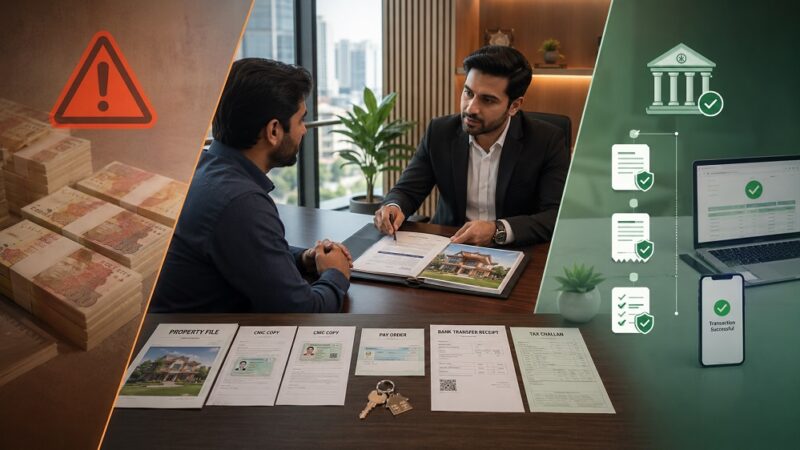
Property buying in Pakistan is changing. For many years, real estate transactions were commonly handled through cash, informal receipts, token money, partial payments, market adjustments and trust-based dealing. In many local markets, this style still exists. But the environment around property transactions is no longer the same. Tax documentation, filer status, source-of-funds questions, anti-benami action, banking records, overseas remittances and international compliance pressure are all becoming more important.
This does not mean every cash payment automatically creates a legal problem. The real issue is more practical. A cash deal is becoming risky because it is harder to prove, harder to explain, harder to defend in disputes, and harder to reconcile with the buyer’s tax and banking record. A buyer may have completely legitimate money, but if the payment trail is weak, the buyer can face problems later when asked to prove how the property was purchased, how the seller was paid, and where the money came from.
For serious buyers, especially overseas Pakistanis, salaried families, documented business owners and long-term investors, property payments should now move through proper banking channels as far as possible. A clean bank payment trail protects the buyer, supports tax compliance, reduces fraud risk, improves future resale confidence and helps the overall market move away from undocumented cash dealing.
This topic is not mainly about bank loans or mortgage finance. A buyer may purchase property with their own funds and still use proper banking channels. The main point is simple: even if you are not taking a loan, your payment should be traceable, documented and connected with a proper sale agreement, seller receipt, tax challan and transfer record.
For related tax planning, buyers can also use Manahil Estate’s Property Tax Calculator with FBR & DC Values and read our guide on property taxes applicable on buyers and sellers from July 2025. These resources help buyers understand how tax and documentation now affect real estate transactions in Pakistan.
Pakistan’s Old Cash Culture in Property Deals
Pakistan’s property market has traditionally been very cash-heavy. In many deals, token money is paid in cash, partial payments are adjusted privately, and the final declared value may not always reflect the actual market value. Some buyers feel cash gives flexibility, speed and bargaining power. Some sellers prefer cash because it avoids banking questions, tax visibility or delays.
This old system developed because the real estate market was informal for a long time. Many buyers trusted dealers, family references, local market reputation or society transfer systems more than bank records. In some housing societies, the transfer process itself was treated as proof enough, while the payment trail remained secondary.
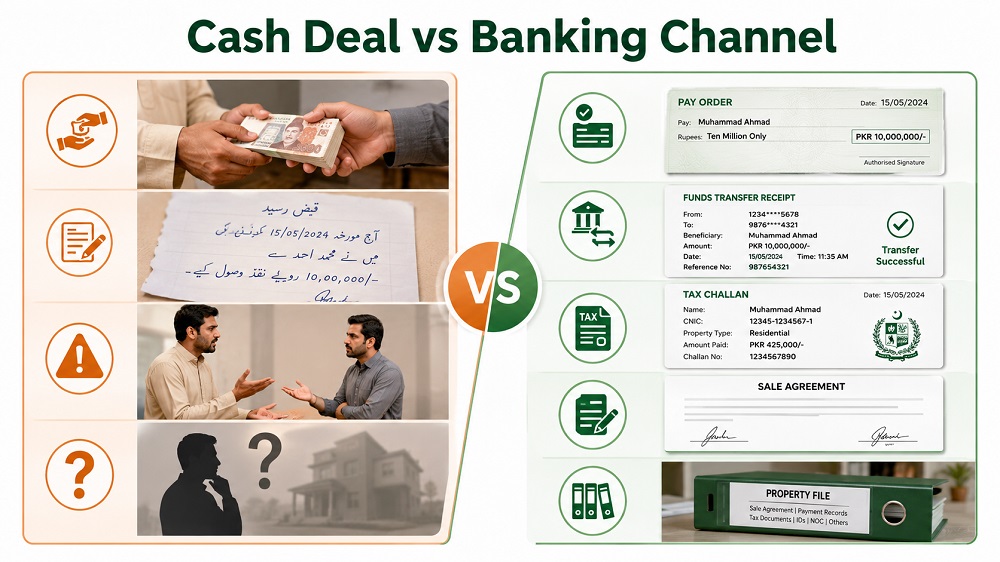
But this informal culture creates serious weaknesses. If a buyer pays a large amount in cash and later faces a dispute, the buyer may only have a handwritten receipt, a witness statement or a dealer’s word. If the seller denies receiving full payment, delays transfer, changes terms or creates pressure for more money, the buyer’s position becomes weaker. In a banking-channel transaction, the payment date, amount, sender, receiver and purpose can be traced more clearly.
This is why the market needs to move from trust-only dealing to proof-based dealing. Trust is important, but in a major property transaction, trust should be supported by bank record, written agreement, tax record and transfer documents.
Why Cash Property Deals Are Becoming Riskier Now
The biggest risk in a cash deal is not only theft or fraud. The bigger issue is that cash breaks the documentation chain. A property transaction should have a clear connection between the buyer’s declared source of funds, the buyer’s bank account, the payment instrument, the seller’s receipt, the sale agreement, the tax challan and the final transfer record. When payment is made mostly in cash, this chain becomes weak.
In the current environment, tax authorities are more focused on documentation. Filer and non-filer differences have become a major part of property transaction cost. Banks are also more alert about large cash movement, suspicious transactions and source-of-funds questions. Real estate agents, brokers, dealers, builders, developers and housing authorities are also part of Pakistan’s AML/CFT compliance environment as designated non-financial businesses and professions. This means the market is slowly moving toward a more documented structure.
Cash deals can also create problems at resale. When a buyer later sells the property, they may need to explain acquisition cost, payment history, tax paid and source of investment. If the purchase was informal and cash-heavy, it becomes difficult to prove the real cost. This can affect tax calculation, dispute handling and buyer confidence.
For overseas Pakistanis, cash dealing is even more dangerous. Many overseas buyers send money to relatives, friends or agents and later discover that the property was not purchased properly, was purchased in someone else’s name, or the payment was not fully delivered to the seller. A bank transfer, Roshan Digital Account route, foreign remittance record or direct payment to a verified seller, developer or society account provides much stronger protection.
What Counts as a Proper Banking Channel?
A proper banking channel means the payment moves through a traceable financial route and connects clearly with the property transaction. The safest options usually include pay order, demand draft, crossed cheque, online bank transfer, inter-bank funds transfer, foreign remittance, Roshan Digital Account transfer, official developer or society challan deposit, or bank deposit into the officially designated account of the seller, society or developer.
The important thing is not only the method. The record should clearly show who paid, who received, how much was paid, when it was paid, and for what purpose. A bank transfer with proper narration is stronger than an unexplained transfer. A pay order in the seller’s name is stronger than cash handed over without clear proof. A society challan deposited into the official account is stronger than cash given to an unknown middle person.
In many property transactions, a pay order or demand draft in the seller’s name is especially useful because it creates a bank-issued proof that can be attached to the sale agreement, transfer file and payment receipt. For developers and societies, payments should preferably be deposited into official project accounts through challan or verified account details, not into personal accounts of unrelated individuals.
For safe documentation, the payment route should match the agreement. If the agreement says payment will be made to the seller, the bank instrument should reflect that. If payment is made to a developer or society, the receipt should come from the official account. If payment is made through a representative, the authority letter, CNIC and role of that person should be clear.
A Safer Property Payment Flow in Pakistan
A safe property transaction should follow a clear payment flow. The first step is to verify the seller and property before paying token. The buyer should confirm ownership documents, CNIC, transfer process, outstanding dues, society or authority status, possession position and any pending dispute. Token should not be paid only because the deal looks urgent.
After verification, the buyer should sign a written agreement that mentions the property details, total price, token amount, balance payment schedule, payment method, transfer date, possession date, tax responsibility, default clauses and refund conditions. The agreement should clearly mention whether payment will be made through pay order, bank transfer, cheque, challan or another traceable method.
Major payments should then move through proper banking channels. If payment is made to an individual seller, the buyer should use a pay order, demand draft, crossed cheque or verified bank transfer in the seller’s name. If payment is made to a society or developer, it should go to the official account through proper challan or bank deposit receipt. Every payment should have a receipt that matches the agreement.
After payment, the buyer should complete tax challans, transfer charges and society or authority requirements according to the actual transaction process. The final file should contain agreement, payment proof, seller receipts, tax challans, transfer letter, possession letter where applicable, and any written communication related to the deal.
This flow may look more formal than old-style dealing, but it protects the buyer. A clean transaction file is often more valuable than a verbal promise from any party.
What If Small Cash Token Is Unavoidable?
In Pakistan’s local market, small cash token still happens in some cases, especially when a buyer wants to secure a deal quickly. The ideal approach is to pay even token through bank transfer or pay order. But if a small cash token is unavoidable, it should be kept limited and fully documented.
The token receipt should mention the buyer’s name, seller’s name, CNIC numbers, property details, amount paid, date, balance payment terms, refund or default conditions, and the purpose of payment. It should be signed by the seller and buyer, and preferably witnessed by reliable persons. CNIC copies should be attached. The same token amount should then be adjusted in the final written agreement.
Large cash payments should be avoided, especially in high-value transactions. A small documented token is one thing; paying major amounts in cash without a banking trail is a completely different risk.
Source of Funds: The Question Buyers Cannot Ignore
Property is usually one of the biggest purchases in a person’s life. When someone buys a plot, house, apartment, shop or commercial unit, the amount involved is significant. A buyer should be able to explain where the money came from. It may come from salary savings, business income, sale of another asset, inheritance, foreign remittance, declared investment, bank savings or family transfer. Whatever the source is, it should be explainable.
This is where banking channels are helpful. A proper bank record shows how funds moved. If money came from overseas, remittance record helps. If money came from sale of another property, the previous sale documents and bank receipts help. If money came from business income, tax returns and bank statements support the buyer’s position. If money came from savings, regular account history can help establish the trail.
Cash weakens this explanation. A buyer may say the money was saved over many years, but without a banking trail the explanation becomes harder to support. This can create tax concerns, especially when the property value does not match declared income or financial profile.
Serious buyers should not treat source-of-funds documentation as an unnecessary headache. It is a protection. A clean source-of-funds record can save the buyer from future notices, family disputes, seller disputes, benami suspicion and resale complications.
Filer Status, Tax Record and Property Transactions
Property transactions in Pakistan are now strongly connected with tax status. Filer, late filer and non-filer categories can significantly change withholding tax and transaction cost. This is one reason why undocumented buyers are feeling more pressure. The system is slowly pushing people to become tax-compliant before making large property purchases.
This direction is not accidental. Pakistan has long faced a narrow tax base, high undocumented wealth, and a large informal economy. Real estate has often been used as a parking place for undeclared money because property can absorb large values. When the government increases documentation, connects transactions with CNIC, filer status, bank records and property valuations, it becomes harder to use real estate only as a hiding place for cash.
From a buyer’s point of view, this means planning is now more important. Before buying property, the buyer should know their filer status, expected buyer tax, seller tax implications, stamp duty, society transfer charges and FBR/DC valuation impact. Manahil Estate’s property tax calculator can help buyers estimate these costs before making a serious decision.
The key lesson is simple: the buyer should not plan only the property price. The buyer should also plan the tax record, payment trail and documentation package.
Anti-Benami Risk and Buying in Someone Else’s Name
Another major issue is benami ownership. In Pakistan, many properties have historically been bought in the name of relatives, employees, friends or other persons while the real investor remained behind the scene. Sometimes this is done for family convenience, but sometimes it is done to hide ownership, avoid tax, protect undeclared wealth or bypass scrutiny.
This practice is now much riskier. Anti-benami laws and enforcement actions have made it clear that immovable property can become a target if the real beneficial owner and the legal owner do not match and the source of funds cannot be properly explained.
For genuine families, this is also a practical warning. If a father buys property in a son’s name, if an overseas brother sends money to a relative, or if a business partner pays through someone else, everything should be clearly documented. Who paid? Who owns? Was it a gift, loan, partnership, inheritance share, or actual purchase? Without clarity, future family disputes and legal complications can arise.
Banking channels help because they show the real movement of funds. But payment trail alone is not enough if ownership structure is unclear. The agreement, receipts, transfer documents and family or business understanding should also match the actual arrangement.
How Cash Deals Add to the Black Economy
Cash-heavy property dealing does not only create risk for individual buyers. It also affects Pakistan’s broader economy. When large property transactions happen outside proper banking channels, money remains outside the documented economy. This creates several problems.
First, tax collection becomes weak. If actual transaction values are hidden or payments are made informally, the state cannot properly collect taxes. This increases pressure on documented taxpayers, especially salaried people and formal businesses, because the government then relies more heavily on the already documented sector.
Second, cash dealing encourages under-declaration. When the declared value is much lower than the actual market value, both buyer and seller may feel they are saving money in the short term, but the market becomes distorted. Official valuations, tax records and real market prices stop matching each other. This creates confusion, mistrust and unfairness.
Third, black money in property pushes genuine buyers out of the market. If undocumented money keeps flowing into plots, files and speculative assets, prices can rise beyond the reach of normal families. This is one reason why real estate can become more attractive for money parking than for actual housing.
Fourth, cash dealing weakens banking depth. Money that should move through banks remains informal. This reduces financial visibility, weakens savings mobilization and limits the ability of the formal financial system to support productive sectors.
For Pakistan’s economy, moving property payments through banking channels is not only about tax collection. It is about building a more reliable market where ownership, payment, value and tax record can be trusted.
IMF, FATF and International Pressure: Why Documentation Is Increasing
Pakistan’s documentation push is also linked with international pressure. The IMF has repeatedly pushed Pakistan toward tax reforms, better revenue collection, governance improvement, reduction of exemptions and broader documentation. These reforms are not always easy for the local market, but they are part of Pakistan’s financial reality.
FATF-related AML/CFT standards have also influenced real estate practices. Globally, real estate is treated as a sensitive sector for money-laundering risk because large amounts can be moved into property, ownership can be hidden, values can be manipulated, and beneficial ownership can become unclear. This is why real estate agents and property professionals are increasingly expected to understand customer due diligence, beneficial ownership and suspicious transaction reporting.
For Pakistan, this means property dealing cannot remain fully informal forever. Banks, tax authorities, real estate agents, developers, societies and buyers are all being pushed toward a more documented system. This transition may feel difficult, but it is necessary if Pakistan wants a safer, more credible property market.
The important point is balance. Documentation should not become so complicated that genuine buyers are discouraged. At the same time, the market cannot remain open for undocumented cash, fake ownership and unclear payment trails. Pakistan needs a system that is strict enough to reduce black money, but simple enough for genuine buyers to follow.
Is This Good or Bad for Pakistan’s Internal Market?
For the short term, stricter documentation can slow down some real estate activity. People who were comfortable with cash deals may hesitate. Some speculative investors may step back. Sellers who prefer undocumented payments may resist banking channels. Dealers may also feel that transactions are taking longer because buyers ask more questions and documentation is more detailed.
But in the long run, this shift is healthier. A documented property market creates trust. Genuine buyers feel safer. Overseas Pakistanis become more confident. Banks, developers and authorities can verify transactions more easily. Legal disputes become easier to resolve because payment records are clearer. Tax collection improves without constantly burdening only the formal salaried class.
The biggest positive impact is that real estate can move from speculation toward real ownership. When payments are documented and source of funds is clearer, it becomes harder to use property only as a silent parking place for undeclared money. This can reduce artificial price pressure and make the market more realistic over time.
However, the government also has responsibilities. If authorities want buyers to use banking channels, the system must be practical. Transfer taxes should not be so high that people are pushed back into under-declaration. Property valuation should be realistic. Bank transfers should be smooth. Society and authority offices should accept documented payments clearly. Tax rules should be understandable. If documentation is made too complicated or too expensive, people will keep looking for informal shortcuts.
How Banking Channels Protect Property Buyers
The first protection is proof of payment. In a bank transaction, the buyer can show payment date, amount and receiver. This matters if the seller later denies payment, delays transfer or disputes the balance amount.
The second protection is source-of-funds clarity. If the buyer’s money moves through declared accounts, remittance channels or documented sale proceeds, it becomes easier to explain the purchase. This is especially important for higher-value transactions.
The third protection is fraud reduction. Cash can be misused by agents, relatives, representatives or fake sellers. Banking channels reduce this risk because the money can be sent directly to the seller’s verified account, society account or developer account.
The fourth protection is future resale. When the buyer sells the property later, clean acquisition records help prove cost, payment history and ownership trail. This can make the next buyer more confident and can reduce disputes during resale.
The fifth protection is family and partnership clarity. If multiple people are contributing money, banking records can show each person’s contribution. This reduces future disputes between brothers, business partners, spouses or relatives.
Banking Channels Also Protect Sellers
Banking-channel payments are not only useful for buyers. They also protect sellers. A seller who receives payment through bank can prove that the buyer paid the agreed amount. This reduces fake payment claims, balance disputes and security risks involved in handling large cash amounts.
A clean receipt of sale proceeds also helps the seller in future transactions. If the seller later buys another property, deposits money into an account, invests in business or explains income in tax records, the bank trail supports the explanation. In a documented market, sellers also benefit from clean records because their future financial movement becomes easier to defend.
For genuine sellers, banking channels reduce unnecessary risk. Carrying large cash, counting cash, storing cash, transferring cash physically and trusting third parties with cash all create avoidable problems. A proper pay order, demand draft or bank transfer is safer and cleaner.
Overseas Pakistanis Should Be Extra Careful
Overseas Pakistanis are among the most important buyers in Pakistan’s property market, but they also face higher risk because they are often not physically present. Many overseas buyers depend on relatives, friends or agents to make payments and handle paperwork. This can work when everyone is honest and professional, but it can also create serious problems if money is mishandled or property is bought in the wrong name.
For overseas buyers, cash dealing should be avoided as much as possible. Payments should preferably move through proper remittance, Roshan Digital Account, bank transfer, pay order or direct deposit into the official account of the seller, society or developer. Every payment should be supported by receipt, agreement, CNIC copies, authority letter where needed, and transfer documents.
Manahil Estate has already discussed overseas investment routes in guides such as how overseas Pakistanis can invest in property of Islamabad and Roshan Apna Ghar Scheme for overseas Pakistanis. The same principle applies here: overseas buyers should keep their investment trail clean, traceable and documented.
An overseas buyer should never send large cash amounts to someone without a written purpose. If money is sent to a relative, the buyer should clarify whether that person is only acting as an agent, receiving funds on behalf of the buyer, or becoming a co-owner. Confusion at this stage can become a family dispute later.
How Property Transactions Become More Reliable Through Banking Channels
A reliable property transaction is one where the buyer, seller, property, payment and tax record all match. Banking channels help create that match.
Before payment, the buyer signs an agreement that mentions property details, total price, payment schedule, payment method, possession timeline, transfer date, tax responsibility and default clauses. When payment is made, the bank record confirms the amount and receiver. When tax is paid, challans support the legal transaction. When transfer happens, the society, authority, registry office or developer record completes the ownership chain.
This creates a complete file. If any issue arises later, the buyer is not dependent only on verbal promises. The buyer has agreement, bank slips, pay order copies, transfer receipts, tax challans and ownership documents. This is how property buying becomes safer.
For developers and societies, banking-channel payments also improve credibility. A project that receives payments in official accounts, issues proper receipts and maintains transparent records is more trustworthy than a project that depends heavily on informal cash handling.
What Buyers Should Keep in Their File
Every serious buyer should maintain a complete property payment file. This file should include the sale agreement, token receipt, seller CNIC copy, property ownership documents, bank transfer receipts, pay order or demand draft copies, society/developer receipts, tax challans, transfer letter, possession letter where applicable, and any correspondence related to payment or transfer.
If the payment is made in installments, every installment should have a proper receipt and bank record. If payment is made to a society or developer, it should be deposited into the official account and not into an unofficial personal account unless legally justified and properly documented.
If a representative is involved, such as a relative, employee or agent, the authority letter and role of that person should be clear. Property transactions involve large amounts, so small documentation gaps can create big problems later.
What Needs to Improve in Pakistan
Pakistan needs banking-channel property transactions, but the system must become easier for genuine buyers. Documentation should be encouraged, not made painful. Buyers will use formal channels when the process is clear, affordable and practical.
The first improvement should be realistic property valuation. Large differences between market value, FBR value and DC value create confusion and encourage under-declaration. A more realistic and stable valuation system would help the market move toward honest documentation.
The second improvement should be lower and simpler transaction costs. If transfer taxes and charges are too high, people look for informal adjustments. Reasonable transaction costs can encourage proper documentation and increase overall compliance.
The third improvement should be digital verification. Buyers should be able to verify ownership, tax status, dues, NOC, approval and transfer requirements more easily. Many disputes happen because information is scattered between societies, authorities, registry offices and tax departments.
The fourth improvement should be stronger professional standards for real estate agents. Agents should guide buyers toward safe payment channels, not push informal cash dealing. Real estate professionals should understand AML/CFT obligations, customer verification and source-of-funds sensitivity.
The fifth improvement should be better public awareness. Many buyers are not trying to evade the law; they simply follow old market habits. If buyers understand how payment trail protects them, they will be more willing to use banking channels.
Practical Advice Before Making a Property Payment
Before paying token, confirm the seller’s identity, ownership documents, property status, outstanding dues, possession status and transfer process. Do not pay major amounts only on verbal commitment.
The agreement should clearly mention total price, payment schedule, mode of payment, seller and buyer details, property details, possession date, transfer date, tax responsibility and refund/default conditions.
Prefer pay order, demand draft, crossed cheque, online transfer, official challan or direct deposit into verified account. Avoid large cash payments, especially in high-value transactions.
Keep payment proof safe. A screenshot alone is not enough; keep bank slips, transaction receipts, bank statements, pay order copies and seller receipts.
For overseas buyers, avoid sending money informally. Use remittance, RDA, bank transfer or direct payment to official accounts. Also keep written authorization if a local representative is handling the transaction.
Before final transfer, verify that all payments, taxes, transfer charges and dues are settled and properly receipted. A clean payment file is as important as the property file itself.
Final Verdict: Property Payments Should Move Through Banking Channels
Pakistan’s property market is moving toward documentation, whether buyers and sellers like it or not. Filer status, source of funds, anti-benami rules, AML/CFT obligations, international pressure and tax reforms are all pushing the market away from informal cash dealing. This transition may be uncomfortable in the short term, but it is necessary for a safer and more reliable property market.
Cash deals may look simple, but they can create serious problems. They weaken payment proof, increase dispute risk, complicate tax explanations, create source-of-funds questions and reduce future resale confidence. For overseas Pakistanis, cash dealing is even more dangerous because distance already increases risk.
Banking channels protect the buyer by creating a clear trail. They show where money came from, where it went, when it was paid and how it connects with the property transaction. This makes ownership stronger, documentation cleaner and resale easier.
For Pakistan’s economy, documented property payments can reduce black money, improve tax compliance, build trust, protect genuine buyers and make real estate more transparent. The government also needs to keep transaction costs reasonable and systems simple so genuine buyers are not pushed back into informal dealing.
The safest approach is clear: buy property with proper documents, pay through traceable banking channels, keep every receipt, understand tax obligations, and avoid vague cash handling. In today’s Pakistan, a clean payment trail is not just a formality. It is buyer protection.
Disclaimer: This article is for general real estate awareness only and should not be treated as legal or tax advice. For high-value transactions, tax notices, benami concerns, inheritance issues or complex ownership structures, buyers should consult a qualified tax or legal professional before making payment.
FAQs
Is it illegal to buy property in cash in Pakistan?
The issue is not only whether cash is legal or illegal in every situation. The real problem is that cash payments are harder to prove, harder to explain and riskier in disputes. For high-value property transactions, buyers should prefer traceable banking channels.
Why are cash property deals becoming risky in Pakistan?
Cash deals are becoming risky because of stricter tax documentation, filer/non-filer pressure, source-of-funds questions, anti-benami action, AML/CFT expectations and future resale verification. A weak payment trail can create problems later.
What is the safest way to pay for property in Pakistan?
The safest method is to pay through proper banking channels such as pay order, demand draft, crossed cheque, online bank transfer, official society/developer challan, remittance or Roshan Digital Account transfer, supported by written agreement and receipts.
Can token money be paid in cash?
Ideally, token money should also be paid through a banking channel. If a small cash token is unavoidable, keep it limited and take a proper signed receipt with CNIC details, property details, witnesses, date, amount, purpose and adjustment terms in the final agreement.
Why is source of funds important in property buying?
Source of funds shows where the buyer’s money came from. It may be salary, business income, savings, sale of another asset, inheritance or foreign remittance. A clear source protects the buyer from future tax and ownership questions.
Should overseas Pakistanis avoid cash property payments?
Yes, overseas Pakistanis should avoid cash payments as much as possible. They should use remittance, Roshan Digital Account, bank transfer or direct payment to official seller/society/developer accounts and keep complete documentation.
How do banking channels protect buyers?
Banking channels create proof of payment, reduce fraud risk, support tax compliance, protect against seller disputes, clarify family or partnership contributions and make future resale easier.
Do banking channels also protect sellers?
Yes. Sellers also benefit because they receive documented proof of payment, reduce cash-handling risk, avoid fake-payment disputes and can explain sale proceeds when they later buy another property, deposit funds or file tax records.
What documents should a buyer keep after payment?
The buyer should keep sale agreement, token receipt, bank transfer receipts, pay order copies, seller CNIC, tax challans, society/developer receipts, transfer letter, possession letter and all payment-related correspondence.
How does documented property payment help Pakistan’s economy?
Documented payments reduce black money, improve tax compliance, increase trust, support formal banking activity, protect genuine buyers and make the real estate market more transparent.
Need Help with a Safe Property Transaction?
At Manahil Estate, we guide buyers, sellers and overseas Pakistanis on practical property buying, documentation, taxes, payment planning and safer transaction procedures. Whether you are buying a plot, house, apartment, shop or commercial property, our team can help you understand the right process before you make payment.
Contact Manahil Estate: 0345 5222253
Office: Office # 202, Plaza # 177, Above Faysal Bank, Spring North Commercial, Bahria Town Phase 7, Rawalpindi.