
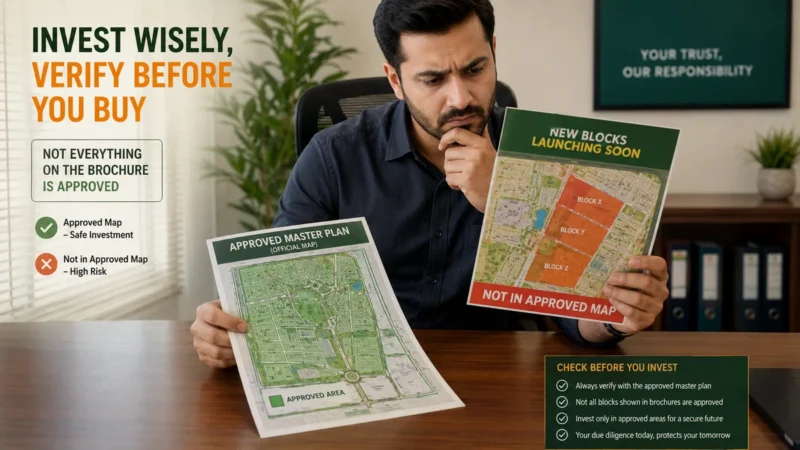
In Pakistan’s real estate market, most buyers ask one basic question before investing in a private housing scheme: “Is the society approved?” This question is important, but it is not complete. A society may have an approved layout plan for one area, while some new blocks, extensions, farmhouses, files or extra plots being marketed may fall outside the approved boundary. This is where many buyers get trapped.
The real risk is not only whether a society name appears in an approved list. The deeper risk is whether the exact plot, block, extension, farmhouse category or file being sold is inside the approved layout plan and covered by a valid NOC. A society can have one legally approved portion and still market another area as “extension,” “executive block,” “overseas block,” “farmhouse block,” “new booking,” “future phase,” or “under-process approval.” If that extra area is not approved, not purchased, not transferred, or not physically available on ground, the buyer may face serious legal and financial problems later.
This is why the difference between approved area and sold area matters. Approved area means the land and layout that the relevant authority has accepted under its planning rules. Sold area means the area, files or plots being offered to buyers in the market. In a healthy and transparent market, both should match. In a risky market, the marketed and sold inventory may go far beyond the approved map, and buyers may not realize it until development, possession, utility connections, transfer or resale becomes difficult.
This problem is now one of the most damaging malpractices in Pakistan’s private housing scheme market. It is not only about illegal societies with no approval at all. A more hidden danger is when a known or partially approved society sells new blocks, future extensions or files that are not part of the approved layout. These files may circulate in the market for years, but if there is no approved land behind them, they can lose value, go into minus, or become almost impossible to resell.
Manahil Estate has already covered related updates in articles like Complete List of CDA Declared Illegal Housing Schemes in Islamabad, RDA Illegal Housing Schemes List, and RDA Approved Housing Schemes in Rawalpindi. This article goes deeper into a more specific risk: how approved area and marketed area can differ, how no-land files are sold, why buyers suffer, and how investors can protect themselves before paying.
What Does Approved Area Mean in a Housing Scheme?
Approved area means the exact land area, layout, roads, residential plots, commercial plots, parks, graveyard, public buildings, utility spaces, access roads and community facilities that have been reviewed and approved by the relevant authority. In Islamabad, this may be CDA for schemes falling in CDA jurisdiction. In Rawalpindi, RDA, PHATA, TMA, district council or other relevant authorities may be involved depending on the exact location and legal category of the project.
A proper approval is not simply a society name written on a brochure. It is connected with a layout plan, land area, khasra numbers, mouza, road access, zoning, public-use spaces, mortgage of plots where required, development obligations, utility planning and final NOC status. The buyer must understand that approval is attached to a specific plan and specific land, not to unlimited future land around the project.
For example, if a society’s approved layout covers a certain number of kanals, the legal planning status applies only to that approved portion. If the society later buys, claims, negotiates or plans additional land and starts selling new blocks before proper revised approval, that new area should not automatically be treated as approved. A buyer must ask whether the exact extension has its own approval, revised layout plan, land ownership and legal backing from the relevant authority.
In simple words, “approved society” does not always mean “every file being sold by that society is safe.” The exact block, exact plot category, exact file and exact map location must match the approved layout.
LOP, NOC and Completion Are Not the Same Thing
Buyers must understand the difference between LOP, NOC and completion. These terms are often used loosely in market conversations, but they do not mean the same thing.
LOP means layout plan approval. It shows that the authority has approved a planning layout for a specified land area, subject to rules and conditions. NOC means no objection certificate for development and sale after the required formalities are completed. Completion certificate means development has been completed according to the approved layout plan, service design and specifications.
A project with only layout approval is not at the same stage as a project with valid NOC. A project with NOC may still not have completed development. A developed and possession-ready block is safer than a file in a proposed or under-approval extension. This is why buyers should not accept vague statements like “approved hai” without asking: approved for what, by whom, on how much land, and does it include this exact block?
Manahil Estate has previously discussed the importance of legal verification in articles such as must-follow guidelines for the sale and purchase of plots and NOC-approved housing projects near Rawalpindi Ring Road. The same principle applies here: approval should be verified against the exact project, exact location, exact block and exact land.
What Is an Illegal Extension?
An illegal extension is an area added, advertised, booked or sold beyond the approved layout plan without proper approval from the relevant authority. It can be attached to an existing society, marketed under the same brand name, or presented as a new block of a known project. Sometimes it looks very convincing because the society’s original area may already have roads, gates, offices, dealers, maps and development activity.
The buyer sees an established name and assumes the new block is also safe. But legally, an extension is not automatically approved just because it is close to or connected with an approved project. It needs proper land ownership, planning approval, revised layout, NOC process and compliance with authority rules.
Illegal extensions are dangerous because they create a false sense of security. The buyer is not investing in a completely unknown project; the buyer thinks they are investing in a known society. This is why approved-area vs sold-area risk is more hidden than normal illegal-society risk.
How Approved Area and Sold Area Can Differ
This issue usually appears when the society has more market demand than legally approved supply. Developers and sponsors see strong buyer interest, so they start marketing extra blocks, future phases or new files before completing approvals. In some cases, the society may have applied for additional land approval but has not received it yet. In other cases, land may not even be fully acquired, consolidated, transferred or legally available.
A common method is to show a large colorful master plan where approved and proposed areas are visually blended. The buyer sees roads, parks, blocks and plot numbers, but does not know which part is approved and which part is only proposed. The difference between “approved layout,” “proposed extension,” “future block,” and “under-process area” is often not explained clearly in sales conversations.
Another common practice is selling files before plot demarcation. Buyers are told that balloting will happen later, development will start soon, and the block is part of future expansion. If approval does not come, land acquisition fails, or the authority objects, buyers may remain stuck with files that are difficult to transfer, difficult to develop and difficult to resell.
Some schemes also use confusing names. A project may have one approved phase, but a new “Phase-II,” “Executive Block,” “Overseas Block,” “Farmhouse Block,” “Lotus Block,” “Cosmos Block,” “Blue Bell Block,” or “Extension Block” may not have the same legal status. The buyer must not rely on naming alone. The buyer should verify whether the exact block appears in the approved layout plan and whether the NOC covers it.
No-Land Files: When the File Exists but the Plot Does Not
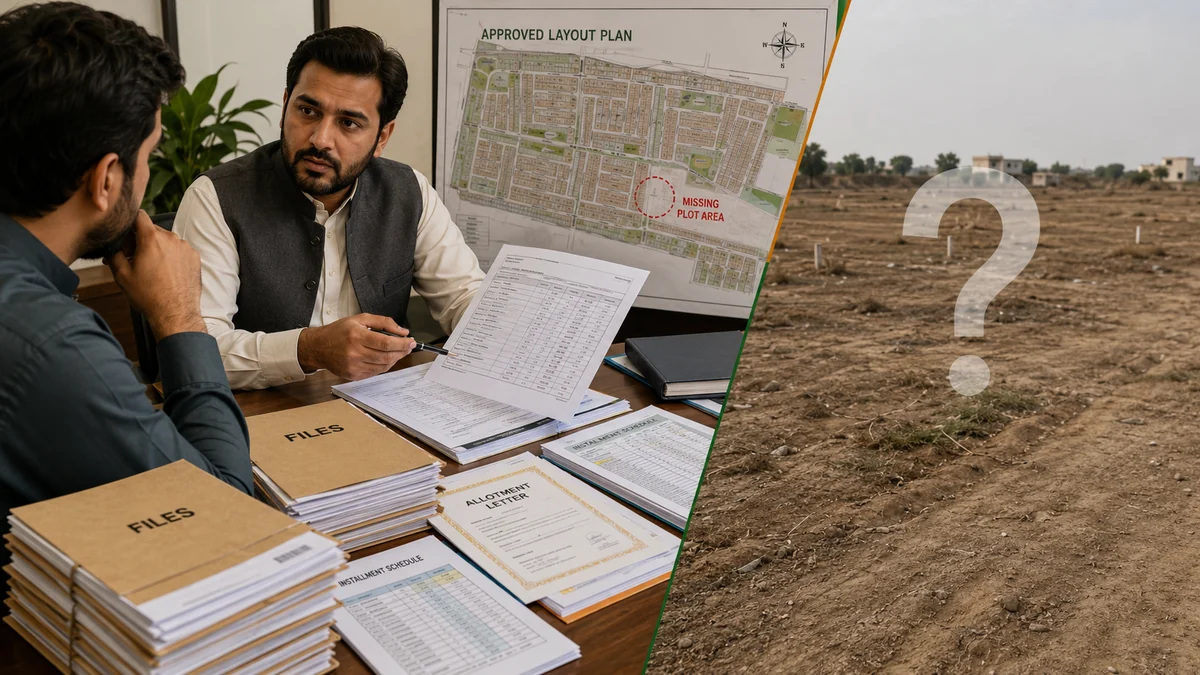
In Pakistan’s housing scheme market, the most dangerous form of approved-area vs sold-area mismatch is the “no-land file.” This happens when a society issues membership files, allocation files or booking files without having enough purchased, transferred, approved and demarcated land behind those files.
For a buyer, the file looks real. It may have a file number, payment receipt, installment schedule, society letterhead, dealer confirmation and even a balloting update. But the real question is not whether the file exists in society records. The real question is whether that file is backed by physical land inside an approved layout plan.
A file without land backing is not a deliverable plot. It is only a paper promise. If the society has not purchased the land, if land is under negotiation, if mutation is incomplete, if litigation exists, if revised layout is not approved, or if the block does not appear in the authority-approved map, then the buyer is carrying a high-risk paper asset.
This is how many investors lose money. They believe they have bought a plot, but in reality they have only bought a claim against a future plot that may or may not be created. When the project fails to acquire land or obtain approval, these files lose value, become difficult to sell, and sometimes start trading in heavy minus in the market.
A file has value only when it is backed by land, approval, development possibility and buyer confidence. Without land and approved map position, it is only a paper promise.
How Societies Sell Future Land Before Actually Owning or Approving It
One of the most common malpractices in private housing schemes is selling future blocks to collect funds first, and using those funds later to purchase land, settle landowners, pay development costs or continue the project. This is extremely risky for buyers because the society is effectively shifting its land-acquisition risk onto the public.
In a safe model, the developer should first acquire land, consolidate ownership, prepare a layout, obtain approval, mortgage required plots where required, and then sell plots according to the approved plan. In the risky model, the developer launches a block first, collects bookings and installments, and later tries to purchase or regularize the land. If everything goes well, the buyers may eventually receive plots. But if land purchase fails, land prices rise, landowners refuse to transfer, authority rejects the layout, litigation appears, or development costs rise, buyers are left with files and no ground reality.
This is why “under process” should never be treated as “approved.” A planned block, under-purchase land, proposed extension, future phase or under-approval area may have potential, but it does not provide the same safety as a block already included in an approved layout. Buyers should understand the difference between a genuine early-stage opportunity and a no-land file risk.
The problem becomes worse when thousands of files are sold before the land is fully secured. Once a large number of buyers are involved, the society may continue taking installments because refunding everyone becomes difficult. Dealers keep the market moving for some time, but once confidence breaks, the same files can become almost unsellable.
A Practical Example: How This Risk Happens
Suppose a private housing scheme receives approval for 1,000 kanals. The approved layout contains residential plots, commercial plots, parks, schools, roads, mosque, graveyard and utility areas within that 1,000-kanal boundary. The project starts selling and demand becomes strong.
Later, the management starts marketing another 600 kanals as “new extension” or “future block.” Dealers tell buyers that approval is under process, land is being acquired, and prices are low because the block is in early stage. Brochures may show the extension connected with the original society, and buyers may assume it is part of the same approval.
But legally, the original approval may cover only the first 1,000 kanals. If the new 600-kanal extension has not been approved, then plots sold there may not be protected by the original NOC. If the authority rejects the revised plan, if required public spaces are missing, if access road is disputed, if land ownership is incomplete, or if the scheme has sold more plots than allowed, buyers can be stuck.
The buyer may hold a file, receipt or allocation letter, but the plot may not exist in the approved map. This is the real danger. A buyer does not only need a paper file; the buyer needs a legally planned, approved and deliverable plot.
Approved Project, Unapproved Blocks: Why the Society Name Alone Is Not Enough
A very important point for Pakistani buyers is that a society may be known, partially developed or approved in some parts, but its new blocks may not automatically be safe. The society name can create confidence, but legal protection comes from the approved layout plan, not from the brand name alone.
This is where many buyers make a mistake. They hear that a society is RDA-approved, CDA-approved or already developed in one area, so they assume every new block, extension or file under the same name has the same legal position. That assumption can be dangerous.
Approval is attached to a specific land area and a specific layout. If the new block is outside that approved area, then the buyer must verify whether a revised layout or separate approval exists. If there is no approval, then the file has no strong legal backing even if the main society has some approved portions.
This is why buyers should not ask only, “Society approved hai?” The better question is: “Is this exact block, exact plot category and exact location included in the approved map?”
Taj Residencia Example: When New Blocks Become a Market Warning
Taj Residencia is a useful example for understanding this risk because it shows how buyers can confuse the legal position of the main project with the legal position of newer marketed blocks. The project has been widely known in the Islamabad-Rawalpindi market, and parts of it have been marketed for years as a major housing scheme. However, RDA’s public record and latest updates have specifically marked Lotus, Cosmos and Blue Bell blocks as illegal.
This example should be understood carefully. The point is not to discuss every part of the project in one line. The point is more specific: even in a known project, a buyer must verify the exact block being purchased. If a block is not part of the approved layout or does not have legal backing from the authority, the file can become high-risk even if the society name is popular.
The market impact of such notices can be severe. When authority status becomes doubtful, files in those blocks can lose liquidity. Buyers who bought at launch or paid installments may struggle to resell. Dealers may quote files in minus because new buyers discount the legal risk. The file may exist on paper, but if the block does not exist in the approved area, has no clear physical demarcation, and has no authority-backed legal standing, then its practical worth becomes weak.
This is the exact danger of approved-area vs marketed-area mismatch. A buyer may think they are buying into a respected or known housing scheme, but the actual file may belong to a block that has no approved map position. In such cases, the buyer’s investment becomes dependent on future regularization, future land acquisition, future approval and future market confidence. That is not a secure investment; it is a speculative risk.
Manahil Estate had previously reported market updates regarding Blue Bell Block balloting, which shows how actively such blocks can circulate in the market. But later authority notices remind buyers that balloting, marketing or file activity should never replace official approval verification. Buyers must always check the latest authority status before payment.
How These Files Become Negative in the Market
In Pakistan’s real estate file market, a file can trade on premium when confidence is strong. But the same file can quickly move into minus when buyers start doubting land, approval, possession or development. This is especially common in blocks where the society sold future inventory before securing all legal and physical requirements.
A file goes into minus when sellers are more than buyers. This happens when existing holders want to exit but new buyers are not ready to take the risk. If the authority issues a notice, if approval is delayed, if development does not appear on ground, if balloting does not lead to possession, or if the market realizes that the block is not inside the approved layout, buyers demand a heavy discount.
This destroys the confidence of small investors. A buyer who paid booking and several installments may not only lose expected profit but may also have to sell below paid value. In some cases, the buyer cannot even find a serious buyer. The file remains in records, but its market liquidity disappears.
This is why investors should not confuse file activity with real value. A file has value only when it is backed by land, approval, development possibility and buyer confidence. Without these, it can become a negative paper asset.
How Overselling Files Damages the Entire Real Estate Market
When one society sells more files than approved or available land, the damage does not remain limited to that project. It affects the whole file market. Buyers begin to question every new booking, every extension and every “under approval” block. Genuine developers also suffer because the market becomes suspicious of all early-stage projects.
This is especially damaging for overseas Pakistanis. Many overseas buyers invest through relatives, dealers or online marketing. They may not visit the site, check khasra numbers, compare approved maps or verify land acquisition. They see a project name, payment plan, balloting update or dealer recommendation and start paying installments. Years later, they may find that the file has no possession, no approved location and no active resale value.
Billions of rupees from overseas Pakistanis and local investors have been stuck in paper investments across different schemes because the files were not backed by ready land and approved layouts. This is one of the biggest reasons overseas investors lose trust in Pakistan’s private housing scheme market. They do not only lose money; they lose confidence in the system.
The file market becomes negative when buyers realize that paper supply is far higher than physical land supply. If thousands of files are circulating but the society has only enough land for a small portion of them, then not every buyer can get a real plot. This creates panic, discounting, refund pressure, litigation and long-term mistrust.
Recent NAB Cases Show the Scale of the Problem
Recent NAB actions and investigations show that the issue is not limited to small disputes between buyers and developers. Housing scheme cases often involve thousands of buyers, large numbers of files, incomplete land, illegal occupation, delayed possession and huge public losses.
One recent example reported in the Islamabad Cooperative Housing Society case shows the scale of the no-land-file problem. Reports stated that investigators found around 42,000 files issued against capacity for only about 6,000 plots, with nearly 36,000 files allegedly unsupported, excessive or illegal. The reported financial irregularities were above Rs16 billion. This is the exact problem buyers must understand: if files are issued far beyond available land and approved layout capacity, thousands of people can hold paper files without real deliverable plots.
Another example is Bankers City Housing Scheme, where NAB and PID reported recovery and refund activity after nearly two decades. This shows how long victims can wait when a housing scheme fraud becomes a recovery case instead of a normal investment. Even when recovery happens, it may take years of complaints, investigation, litigation and verification.
For buyers, the lesson is simple. Do not wait for NAB, courts or authorities to rescue your investment later. The safest stage to protect yourself is before payment. Once thousands of files are sold and money is collected, recovery becomes difficult, slow and uncertain.
Why Overseas Pakistanis Are Hit Hardest
Overseas Pakistanis are often targeted with emotional and trust-based marketing. Blocks are sometimes branded as “Overseas Block,” “Executive Block” or “Premium Block” to create confidence. Dealers may send attractive maps, drone videos, payment plans, balloting updates and WhatsApp messages, while the overseas buyer may not know whether the block is actually approved or physically available on ground.
The biggest problem for overseas buyers is distance. They cannot regularly visit the site, meet authority officials, check development progress or verify land records. They rely on agents, relatives and online material. If the block later turns out to be outside approved layout or without proper land backing, recovery becomes difficult.
Another problem is time. Overseas buyers often pay installments quietly for years, assuming the project will mature. By the time they realize the file is weak, market liquidity may already be gone. Dealers may stop offering buyback, society may delay refunds, and the buyer may have to enter a long complaint or legal process.
This is why overseas Pakistanis should be more careful than local buyers. They should not buy any file only because the society name is known or the payment plan looks easy. They should demand approved layout proof, block inclusion proof, authority verification, land status, payment record and refund policy before sending money.
For overseas-specific guidance, readers can also review Manahil Estate’s article on how overseas Pakistanis can invest in property of Islamabad.
Why Housing Societies Use These Tactics
Not every delay or extension is fraud. Sometimes a developer genuinely plans future expansion and later completes approvals. But in Pakistan’s real estate market, the risk begins when future approval is marketed like confirmed approval.
There are several reasons why some societies or sponsors sell beyond approved area. The first reason is cash flow. Selling files generates money before development is completed. If a developer needs funds to buy more land, develop roads, settle disputes or continue marketing, file sales become a quick source of cash.
The second reason is market hype. Once a project becomes popular, management and dealers want to keep selling. If approved inventory is limited, a new block keeps the sales cycle alive. Low pre-launch prices attract small investors, especially those who missed earlier rates.
The third reason is speculation. Many buyers are not looking for possession; they are looking for profit on file trading. This encourages developers to launch more files because the market itself is willing to buy paper promises without immediate possession.
The fourth reason is weak enforcement. If authorities act late, sponsors may sell thousands of files before action is taken. By the time notices appear, many buyers have already paid installments. This creates pressure on authorities and sympathy for buyers, while the core planning violation remains unresolved.
The fifth reason is buyer negligence. Many buyers ask about price, location and installment plan, but do not ask for approved layout plan, NOC, khasra details, approved area, mortgage status, utility spaces and exact block approval. This gives room to weak projects and illegal extensions.
How Buyers Suffer from Illegal Extensions and No-Land Files
The biggest loss is uncertainty. A buyer may keep paying installments for years without knowing whether the exact plot will ever be approved, balloted, developed or transferred. The file may exist in society records, but the land may not be legally ready for possession.
The second problem is delayed possession. Even if the society is not completely illegal, the extension can remain stuck because approvals, land acquisition, revised layout or development permissions are pending. Buyers who expected possession in two or three years may wait much longer.
The third problem is resale difficulty. When market confidence drops, files in doubtful extensions become hard to sell. Dealers may offer low rates or refuse to deal. A buyer who invested for profit may find that the file has no active buyer.
The fourth problem is utility and infrastructure risk. Roads, electricity, gas, water, sewerage, parks and public spaces depend on approved planning and development. If an extension is outside approved layout, utilities may not be provided or may be delayed for years.
The fifth problem is legal exposure. Authorities may stop development, ban sale and purchase, issue notices, seal offices or take enforcement action. In some cases, illegal construction can be demolished or stopped. The buyer then has to deal with refunds, litigation or long uncertainty.
The sixth problem is emotional and family stress. Many people invest life savings, overseas remittances, retirement funds or children’s future funds into plots. When they discover that the land is not properly approved, the financial loss becomes a family crisis.
Why Lack of Regulation and Enforcement Happens
Pakistan does not lack rules on paper. The issue is weak implementation, overlapping jurisdictions, delayed enforcement, political pressure, land-record complexity, and the gap between planning law and market behavior.
In many areas, buyers do not know whether a scheme falls under CDA, RDA, PHATA, TMA, district council or another authority. Developers sometimes use this confusion in marketing. They may say approval is under one authority while the buyer assumes another major authority has approved it.
Land records are also complex. A scheme may claim possession or ownership of large land, but actual land may be scattered across different khasra numbers, owners, mouzas and legal disputes. Consolidating land into one properly planned housing scheme is not simple. When land is not fully acquired, selling plots becomes risky.
Another problem is that authorities often issue public notices after schemes have already marketed heavily. Notices are useful, but late action means buyers may already be trapped. Enforcement must be faster and more visible at the early marketing stage.
There is also a cultural issue in the property market. Many buyers trust dealer networks, WhatsApp promotions, social media maps, office setups and “booking open” campaigns more than official authority websites. This makes it easy for unapproved projects and extensions to attract money before buyers verify documents.
The Real Test: Total Files vs Total Approved Plots
One of the most important questions buyers should ask is: how many files have been issued, and how many plots are actually available in the approved layout?
A society may show an attractive master plan, but if it has issued far more files than its approved map can accommodate, buyers are at risk. The difference between total issued files and total approved or deliverable plots is the hidden danger. If that gap is large, the market is running on paper supply rather than real land supply.
Buyers should ask whether balloting has been done, whether plots are physically demarcated, whether the block appears on the approved map, and whether possession can be given. If a file is unballoted, unapproved, undemarcated and dependent on future land purchase, it should be treated as high-risk.
The buyer should also ask whether public amenities, roads, parks, graveyard, schools and utility spaces are properly included in the approved layout. Sometimes overselling happens because societies try to create more saleable plots by squeezing planning standards or ignoring public-use spaces. This can create authority objections and long-term livability issues.
What Buyers Should Check Before Buying in Any Extension Block
Before buying in any extension, new block or pre-launch area, the buyer should ask for the approved layout plan and check whether the exact block appears in it. If the block does not appear, then the buyer should treat it as proposed, not confirmed.
The buyer should ask for the total approved area in kanals and compare it with the total area being advertised. If a society is approved for one area but marketing a much larger master plan, the buyer should ask which part is approved and which part is future expansion.
The buyer should verify the NOC status directly from the relevant authority’s website or office. Do not rely only on screenshots, dealer messages or social media posts. Authority records should be checked in real time because statuses can change, notices can be issued, and approvals can be revised, cancelled or limited to specific areas.
The buyer should check whether the plot is residential, commercial, farmhouse, apartment or agro-farming category, because each category may have different rules. A farmhouse or agro-farming scheme should not be treated like a normal residential plot unless the authority has approved it accordingly.
The buyer should ask whether the land is fully acquired, whether mutation or ownership is complete, whether there are any court cases, whether the society has mortgaged required plots with authority, and whether development permissions cover that exact area.
If the seller or dealer says “approval under process,” the buyer should understand that this is not the same as approved. Under-process investment may have upside, but it also carries risk. It should be priced accordingly and should not be treated as secure possession-ready investment.
Red Flags in Private Housing Schemes
A major red flag is when a society advertises a very large master plan but cannot provide an authority-approved layout for the exact block being sold. Another warning sign is when dealers are selling files aggressively but cannot show land ownership, NOC, LOP or approved map.
Low prices can also be a red flag. If a project is offering very cheap plots in a location where legal land is expensive, the buyer should ask why. Sometimes low price reflects early-stage opportunity, but sometimes it reflects legal uncertainty, incomplete land, missing approval or speculative file selling.
Another warning sign is misuse of city names. Some schemes use Islamabad, Rawalpindi, Ring Road, Motorway, Airport, DHA, Capital or Overseas names to create trust, even when the actual jurisdiction, approval status or location is different from buyer assumptions.
Heavy social media promotion without official documentation is also risky. A professional office, attractive map, celebrity marketing, dealer network or installment plan does not replace legal approval.
Finally, buyers should be careful when a society says “possession soon” but the area has no road access, no development, no utility planning and no approved demarcation. Possession is not a slogan; it should be backed by land, development and authority compliance.
How Illegal Extensions Affect Investment Value
Illegal extensions directly damage liquidity. A file may trade actively during hype, but once legal questions appear, buyers disappear. Investors who bought for short-term profit may find themselves stuck because the market starts discounting the risk.
They also damage price stability. Approved, possession-ready and developed areas usually hold value better because buyers can verify what they are buying. Unapproved extensions depend heavily on news, rumors and dealer sentiment. One notice from the authority can reduce market confidence quickly.
Illegal extensions also create unequal risk. Early sellers may exit with profit, while later buyers are left with uncertain files. This is why speculative file trading in unapproved extensions is especially dangerous for small investors and overseas Pakistanis who cannot monitor ground reality.
For end-users, the risk is even bigger. An investor may wait, but a family planning to build a home needs legal possession, utilities, roads and services. Buying in an unapproved extension can delay home construction for years.
What Authorities Should Improve
Authorities need to make approval information easier for the public. Every approved society should have a clear online record showing approved area, approved layout plan, NOC status, date of approval, khasra or mouza details where possible, and whether any extension is approved or not.
Public notices should not only list illegal society names; they should also highlight illegal extensions, cancelled layouts, expired approvals, unauthorized blocks and schemes selling beyond approved area. This would help buyers understand the exact risk.
Authorities should act earlier against misleading advertising. If a society is selling a block not covered by approved layout, action should be taken at the marketing stage before thousands of buyers pay installments.
Real estate advertising should also be regulated more strictly. Any society advertisement should clearly mention approving authority, NOC number, approved area, and whether the advertised block is approved or under process. Misleading phrases like “approved soon” or “authority cleared” should not be allowed without documentary proof.
There should also be stronger coordination between land-record offices, development authorities, electricity/gas departments and local administrations. Illegal extensions often survive because one department acts late while another department has incomplete information.
NAB’s proposed digital verification direction is also relevant here. Manahil Estate has covered NAB’s Digital One-Click system to curb real estate fraud in Islamabad and Rawalpindi. A practical digital verification system can help buyers check project status, approval, land backing and fraud alerts before paying money.
What Developers and Societies Should Do
Good developers should separate approved and proposed areas clearly. If an extension is under process, it should be marketed honestly as under process, not as approved. Buyers should be told what stage the approval is at, what risks exist, and what happens if approval is delayed or rejected.
Societies should avoid selling more plots than their approved layout can accommodate. Overselling destroys trust and creates long-term legal problems. A society that wants long-term credibility should protect its buyers, not only its sales volume.
Developers should also maintain transparent payment and refund policies. If a block is not approved within a promised time, buyers should have a clear remedy. Without such protection, buyers carry all the risk while sponsors enjoy the cash flow.
Responsible developers should sell less, deliver more, and keep their inventory connected with real land. In the long run, this is better for the entire market because investor confidence is more valuable than short-term file sales.
What Buyers Should Do Before Payment
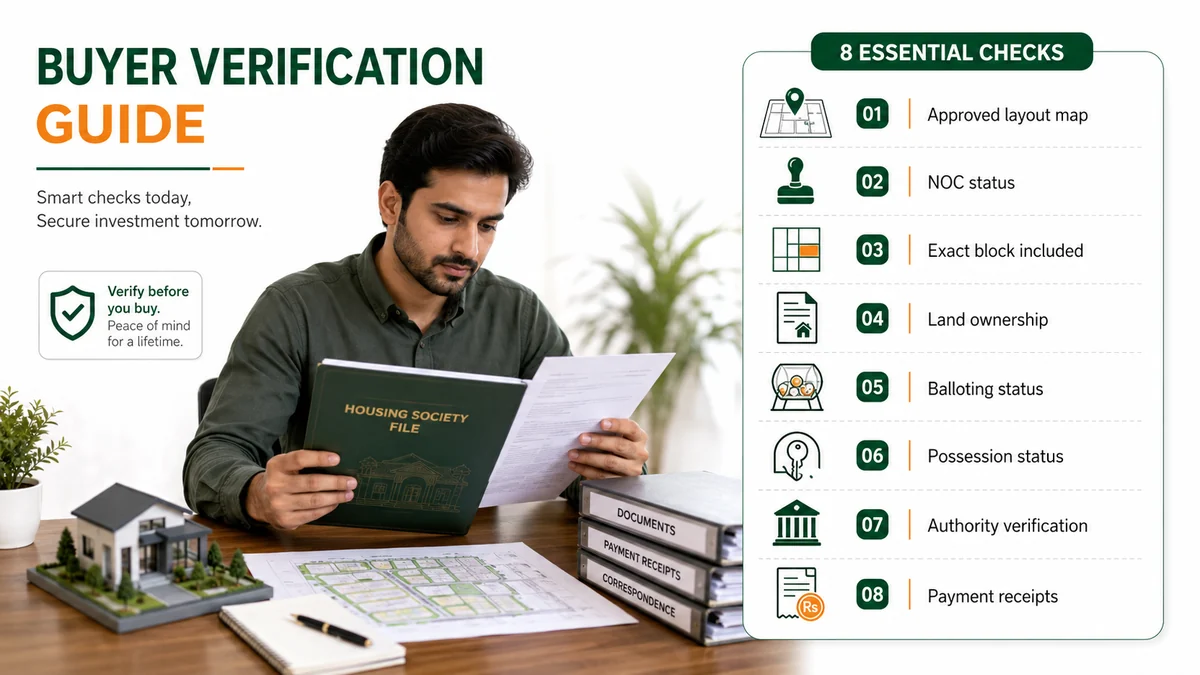
Before making any payment, verify the society from the official authority source. Check whether the society is approved, whether the NOC is issued, and whether the exact block or extension is included in the approved layout.
Ask for the approved map, not only the marketing map. Compare the plot or block location with the approved layout. If the dealer cannot show the approved map, do not rush payment.
Check the authority jurisdiction. A project advertised as Islamabad may actually fall outside CDA jurisdiction. A project marketed near Rawalpindi may fall under RDA, TMA, PHATA or another body. The correct authority matters.
Ask how many files have been issued and how many plots are available in the approved layout. If the society cannot answer this clearly, the buyer should be careful.
Check whether the file is balloted, whether the plot is demarcated, whether possession is available, and whether the plot exists on ground. A non-balloted, non-demarcated, unapproved file should be treated as a speculative paper investment, not as a secure plot.
Use banking channels for payments and keep every receipt. If the legal status is unclear, avoid paying large amounts. If you still choose to invest in an under-process area, treat it as high-risk and price it accordingly.
Consult a reliable real estate advisor before buying in any extension block. A small verification cost can save years of stress and financial loss.
Final Advice for Investors
Approved area vs illegal extension is one of the most hidden risks in Pakistan’s private housing society market. A buyer may think they are investing in a known society, but the exact plot or file may fall outside the approved layout. This is why legal verification must go deeper than the society name.
A safe investment is not only about low price, location or installment plan. It is about legal clarity, approved layout, valid NOC, deliverable plot, development status, possession possibility and resale liquidity. If any of these are missing, the buyer should slow down and verify before paying.
Pakistan’s real estate market needs stronger enforcement, clearer online records, honest advertising and more informed buyers. Until that system becomes fully reliable, buyers must protect themselves by asking the right questions.
The most important question is not simply: “Is the society approved?”
The real question is: “Is my exact plot, block or extension inside the approved layout and covered by a valid NOC?”
An even deeper question is: “Does my file have real land behind it, or is it only a paper promise?”
If the answer is not clearly supported by official documents, approved map, land status and development reality, the investment should be treated as risky.
FAQs
What is the difference between approved area and sold area in a housing society?
Approved area is the land and layout officially approved by the relevant authority. Sold area is the land, plots or files being offered to buyers. If a society sells plots or files beyond its approved layout, buyers may face legal, possession and resale risks.
Is an extension block automatically approved if the main society is approved?
No. An extension block is not automatically approved just because the main society has approval. The extension must be included in the approved layout or have its own revised approval/NOC from the relevant authority.
What is a no-land file?
A no-land file is a file that exists in society or market records but is not backed by enough purchased, approved, demarcated and deliverable land. The buyer may have a receipt or file number, but the actual plot may not exist on approved map or ground.
How do societies sell illegal extensions or no-land files?
Some societies launch future blocks before land purchase or approval is complete. They sell files, collect installments and tell buyers that approval or land acquisition is under process. If approval or land purchase fails, buyers can get stuck with weak files.
Why do files go into minus?
Files go into minus when buyers lose confidence because of delayed approval, no development, no land backing, authority notices, oversupply or weak resale demand. Existing holders try to exit, but new buyers demand a discount for taking the risk.
Why are overseas Pakistanis more vulnerable?
Overseas Pakistanis often rely on dealers, relatives, online maps and WhatsApp updates. They cannot regularly verify site progress, approved maps or land ownership. This makes them more vulnerable to unapproved blocks and no-land file schemes.
What should I check before buying in a new block?
Check the approved layout plan, NOC status, approving authority, total approved area, exact block location, land ownership, total issued files, balloting status, development status, transfer process and whether the block appears in official authority records.
Is “approval under process” safe for investment?
Approval under process is not the same as approved. It may have future potential, but it carries legal and development risk. Buyers should treat it as high-risk and should not pay large amounts without understanding the consequences.
Can a society sell more files than approved plots?
It should not sell more files than its approved and deliverable plot capacity. Overselling can create serious problems because the society may not have enough land, roads, public spaces or utility planning to deliver all promised plots.
How can I verify if a housing scheme or block is approved?
Check the official website or office of the relevant authority such as CDA, RDA, PHATA, TMA or other local authority. Do not rely only on screenshots, dealer messages, YouTube videos or social media posts.
Need Help Verifying a Housing Society?
At Manahil Estate, we guide buyers and investors on legal status, NOC verification, approved layout checks, location analysis and safer investment options in Islamabad and Rawalpindi. Before buying a plot, file or extension block, verify the project properly so your investment is protected.
Contact Manahil Estate: 0345 5222253
Office: Office # 202, Plaza # 177, Above Faysal Bank, Spring North Commercial, Bahria Town Phase 7, Rawalpindi.









Very informative article! I have also written a detailed guide about Punjab government housing schemes — especially for eligibility checking and the application process.