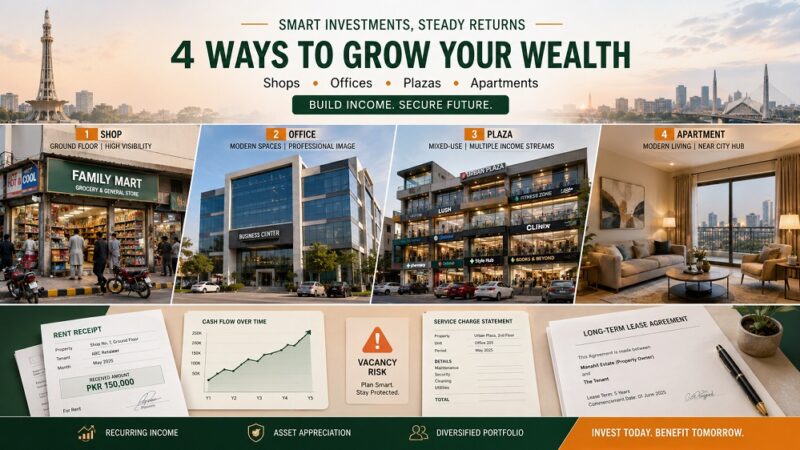
Commercial property has always been one of the most attractive investment ideas in Pakistan. A good shop in a main commercial market, a properly located office, or a well-planned plaza can genuinely generate strong rent and long-term appreciation. In many cases, prime commercial property can outperform residential property because the tenant is not only using space; the tenant is using that location to run a business and earn money.
But this is only true where demand is real. Commercial property becomes highly lucrative when it has visibility, footfall, access, limited nearby commercial supply, and serious business tenants. A ground-floor shop in a main market, with established brands or long-term business occupants, can become one of the strongest rental assets in Pakistan. On the other hand, a shop in a dull plaza, an upper-floor retail unit with no movement, or a small office in a weak building can remain vacant for months and block capital.
This is why the correct comparison is not simply commercial property versus apartment. The real comparison is between a strong income asset and a weak income asset. A prime commercial property can be much better than an apartment, but a weak commercial property can be worse than a well-located apartment. Similarly, an apartment is not automatically safe, but if it is near a city center, main hub, hospital, university, office district, secure society or active rental belt, it can produce regular income, especially when furnished and managed properly.
For lower and mid-budget investors, this question has become more important. Many investors cannot afford prime ground-floor commercial property in developed markets. The option available to them is often a small shop inside an under-construction mall, a lower-visibility office, a basement unit, or an upper-floor commercial space sold on future rental promises. In that situation, a well-located studio, 1-bed or 2-bed apartment may generate better real cash flow if the investor can furnish it, maintain it, market it and use monthly or short-stay rental opportunities.
At Manahil Estate, we believe the final answer depends on budget, location, visibility, tenant demand, lease terms and management capacity. Investors can compare active market options through properties in Pakistan, shops for sale, commercial plots for sale, apartments for sale in Islamabad and apartments for sale in Rawalpindi. But before choosing any option, the investor must understand one basic rule: rent written on paper and rent received in pocket are not the same thing.
Real Cash Flow Is Different from Promised Rent
Most rental investors in Pakistan start with a very simple calculation. They take expected monthly rent, multiply it by twelve, and divide it by the purchase price. This gives a rough gross yield, but it does not show the real return.
For example, suppose a shop is purchased for Rs 1 crore and someone says it can rent for Rs 70,000 per month. On paper, the annual rent becomes Rs 8.4 lakh. This looks attractive. But if the shop remains vacant for two months after a tenant leaves, if service charges are high, if the owner has to repair shutters, flooring, electrical work or signage points, and if an agent commission is paid again to find a new tenant, the actual return becomes much lower.
The same applies to apartments. A furnished apartment may earn higher rent than an unfurnished apartment, but furniture, appliances, cleaning, repairs, linen, utilities, guest handling and vacancy days must be calculated. A plaza may collect rent from multiple tenants, but lift maintenance, security, common area cleaning, service-charge disputes, repairs and tenant turnover can reduce the owner’s actual income.
International investors normally judge income property through net operating income and cap-rate logic. In simple words, they ask: after realistic expenses, how much income is left, and is that return fair compared with the price and risk? Pakistani investors do not need complicated financial models for every small property, but they do need the same discipline. The correct question is not “rent kitna hai?” The correct question is: after vacancy, expenses, management and resale risk, how much real cash flow will remain?
Why Prime Commercial Property Can Be Highly Lucrative
Commercial property becomes powerful when it gives a business tenant a real earning opportunity. A pharmacy does not pay rent for walls. It pays rent for access to customers. A grocery store pays rent because people living nearby need daily items. A food outlet pays rent because the location brings orders. A clinic, salon, bank, mobile shop or branded retailer pays rent because the address supports business.
This is why the best shops are usually in main commercial markets, active society centers, high-visibility roads, populated residential catchments, and places where commercial supply is limited. When there are many residents and limited good commercial units, rents stay stronger. When the shop is visible, accessible and surrounded by active businesses, the tenant has a better chance of earning. In such cases, commercial property can easily outperform apartments.
Long-term lease quality also matters. A shop occupied by an established brand, pharmacy, grocery chain, bank, clinic, food business or long-running local business is more valuable than a vacant shop with only expected rent. A strong tenant reduces uncertainty. A written lease with clear rent, duration, escalation, security deposit and maintenance responsibility protects the owner. This is where commercial property becomes a true income asset.
However, such commercial property usually requires a higher budget. Prime frontage, ground-floor access, main commercial visibility and established tenant demand are not cheap. Investors who want the return of prime commercial must be ready to pay for prime commercial fundamentals. Buying a weak unit and expecting prime rent is where mistakes start.
Where Commercial Property Becomes Risky
Commercial property becomes risky when the investor buys the label instead of the demand. Many small investors buy a shop because it is called commercial, but they do not check whether people will actually come there. A shop in a dull corridor, a basement with poor access, an upper-floor mall location, or a project without surrounding population may look affordable, but affordability alone does not create rent.
The common problem in Pakistan is that many commercial units are sold on future expectations. The investor is told that once the project is complete, brands will come, food court will activate, footfall will increase, and rents will rise. Sometimes this happens, but many times it does not happen at the speed investors expect. Meanwhile, service charges may start, maintenance costs may appear, and the unit may remain vacant.
This is the difference between real commercial property and brochure commercial property. Real commercial property has current or clearly visible tenant demand. Brochure commercial property depends mostly on future hope. There is nothing wrong with future-growth investment if the investor understands the risk, but it should not be treated as confirmed rental income.
A serious investor should look at a commercial unit and ask practical questions. Is there an existing market around it? Are nearby shops already rented? Are brands or established businesses operating nearby? Is there evening activity? Can customers park? Is the unit visible from the main movement line? If the current tenant leaves, who is the next likely tenant? If the answer is unclear, the investor should be careful.
Shop Investment in Pakistan: The Best Option When Visibility and Footfall Are Proven
Among all commercial options, a shop is usually the most attractive for rental income because retail tenants pay for customer access. A ground-floor shop with frontage in a running market can become a strong income asset. This is especially true in populated societies, CDA sectors, DHA commercial pockets, Bahria Town commercial areas, Blue Area-style business districts, and other locations where people already live, work and shop.
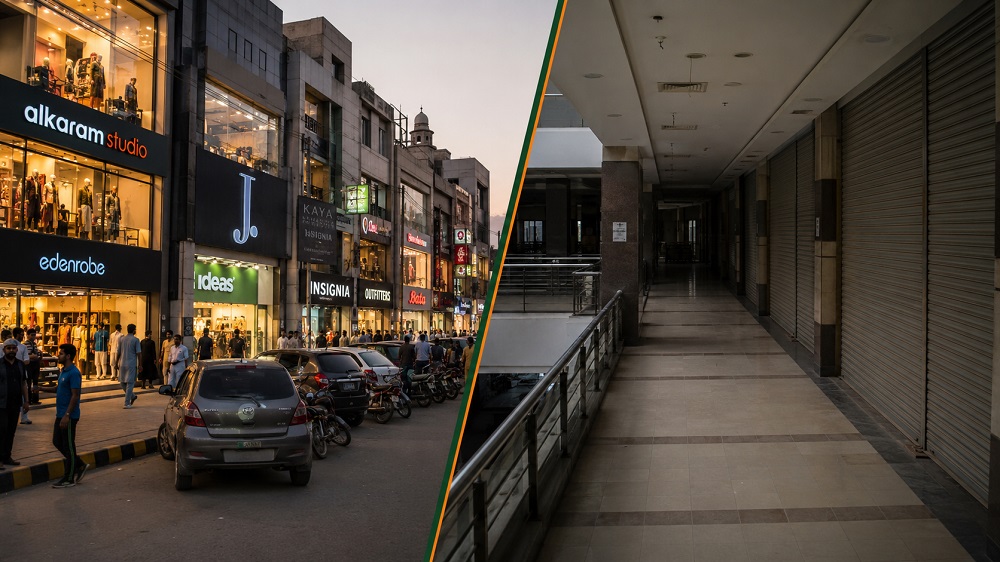
But the strength of a shop depends heavily on exact position. Two shops in the same plaza can perform very differently. The front-facing ground-floor shop may rent quickly and resell easily, while an inner corridor shop may struggle. A corner shop or road-facing shop may attract a premium, while an upper-floor unit may need a destination-type tenant. This is why investors should not judge only by project name. They should judge exact unit position, access, frontage and tenant usability.
A shop is usually stronger when it serves daily-use demand. Pharmacies, grocery stores, bakeries, salons, clinics, mobile accessories, courier points, bank/ATM spaces, food outlets and small branded retail often work because they solve regular needs. A market that serves daily needs usually has more stable footfall than a market dependent only on occasional shopping.
In Islamabad and Rawalpindi, investors can study active commercial behavior through pages such as shops for sale in Islamabad and shops for sale in DHA Islamabad. These pages should not be used as a blind buying signal, but they can help investors compare asking prices, areas, sizes and current availability before doing deeper due diligence.
The main rule is simple. A shop should be bought on actual footfall, visibility and tenant demand, not only on expected rent. If the shop is visible, accessible, in a main commercial market, and can attract a serious tenant on a long-term lease, it can be one of the best assets in Pakistan. If it is hidden, dull, oversupplied or dependent only on future promises, it can become a burden.
Office Investment: Good in Business Hubs, Weak in Random Buildings
Office investment follows a different logic from shop investment. A shop needs retail customers. An office needs business users. The tenant is not looking for walk-in shopping footfall in the same way; the tenant wants a professional address, access for staff, parking for clients, a working lift, clean common areas, security, internet reliability and a building that supports business activity.
Good offices can perform well in proper business locations. IT firms, consultants, clinics, real estate offices, academies, law firms, accounting firms, travel agencies, call centers and small corporate branches all need office space. But such tenants are selective. They will not pay strong rent for a building where clients cannot park, the lift does not work, the entrance is poorly maintained, or the surrounding area does not feel professional.
This is why a cheap office is not always a good investment. In many cases, the office is cheap because demand is weak. If the building has no business activity, no parking, no proper maintenance and no recognizable address value, the investor may face long vacancy. On the other hand, an office in a serious business building can provide a stable tenant if the size, rent and location match market demand.
Office investment is usually better for investors who understand tenant behavior. It can be useful in the right building, but for lower-budget investors, it should be approached carefully. If the choice is between a weak office and a well-located apartment, the apartment may provide broader tenant demand and easier occupancy.
Plaza Investment: A Strong Asset Only When Managed Like a Business
A plaza can be a powerful long-term asset because it can create multiple rent streams. A well-planned building can have ground-floor shops, upper-floor offices, clinics, academies, consultants or apartments where allowed. If the location is active and the building is managed properly, a plaza can give both rental income and long-term land-backed value.
But a plaza is not passive income in the simple sense. It requires active thinking. The owner must understand approvals, commercial use, parking, floor planning, lift, security, maintenance, tenant mix, lease documentation, repairs, rent collection and vacancy management. A small plaza in a running market can perform better than a larger building in a speculative location because the smaller building may have clearer tenant demand.
The biggest mistake in plaza investment is judging only total covered area or number of units. A plaza should be judged by whether every part of it has a practical tenant use. The ground floor should attract daily-use businesses. Upper floors should have a clear office, clinic, academy or service-use case. If upper floors have no natural demand, the building may look complete but income will remain weak.
For experienced investors, a plaza can be an excellent asset. For beginners or passive investors, it can become complicated. A person who wants simple monthly income may be better served by a strong rented shop, a well-located apartment, or a professionally managed income asset instead of an unmanaged plaza.
Apartment Investment: Why It Can Beat Weak Commercial Property
Apartments are becoming more relevant in Pakistan because urban living patterns are changing. Land prices have increased, travel time matters more, and many tenants prefer secure buildings with lifts, parking, maintenance and access to commercial areas. In Islamabad, Rawalpindi, Lahore and Karachi, apartments near business hubs, hospitals, universities, city centers and secure societies are becoming practical rental assets.
The strength of apartment investment is not always the highest rent. Its strength is wider tenant demand. A good apartment can attract families, bachelors, students, working professionals, corporate tenants, medical visitors, overseas Pakistanis and short-stay guests in selected locations. This broader demand can reduce vacancy compared with a weak commercial unit.
This matters most for lower-budget investors. If an investor cannot afford prime commercial property, the available commercial option may be weak: an upper-floor shop, basement unit, small office with parking problems, or mall shop with no footfall. In that case, a well-located studio, 1-bed or 2-bed apartment can be more practical. It may not sound as lucrative as “commercial,” but it can produce more regular occupancy and easier resale.
Investors comparing vertical residential options can review apartments for sale in Islamabad and apartments for sale in Rawalpindi. For a broader view of why vertical living is becoming more relevant in Pakistan, Manahil Estate’s guide on vertical living vs horizontal expansion in Pakistan real estate is also useful.
Still, apartment investment also needs care. A building with poor maintenance, high service charges, low occupancy, weak construction quality or unclear approvals can create problems. The apartment should be in a real rental belt, not just any building with a fancy brochure.
Furnished and Short-Stay Apartments: Higher Income Potential, Higher Involvement
Furnished apartments can produce better income than normal rentals in the right location. A professional shifting to Islamabad for work, a small family waiting for house possession, an overseas Pakistani visiting temporarily, a student, a medical visitor or a corporate employee may prefer a ready-to-live apartment. They do not want to buy furniture for a short stay, so they are willing to pay more for convenience.
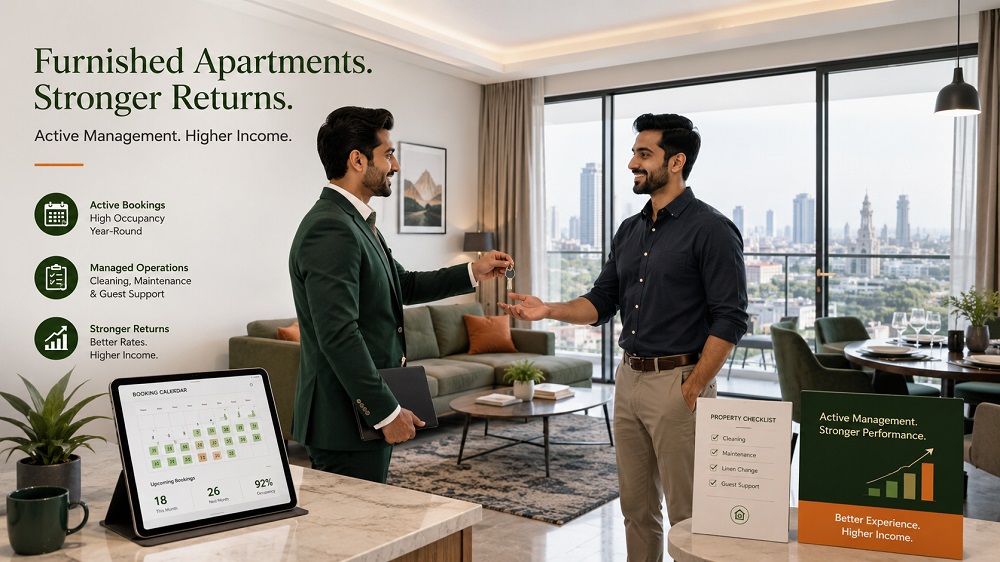
This is where apartments can compete strongly with small commercial units. If the apartment is near a city center, office district, hospital, university, business hub, main road or secure society, and if the owner furnishes it properly, markets it actively and maintains it well, the income potential can improve. A serviced-apartment or short-stay model can earn more than a standard rental, but it is not effortless.
The investor must calculate one-time furnishing cost and recurring costs. Furniture, appliances, mattresses, curtains, kitchen items, ACs, cleaning, repairs, utilities, linen and guest handling all matter. The apartment may also remain vacant for some days between guests. So the monthly income can be higher, but it also comes with active involvement and operational risk.
This is why the furnished apartment model suits investors who can manage it properly or hire someone reliable to manage it. It does not suit an investor who wants completely passive income and cannot handle guest movement, maintenance complaints, cleaning schedules and online marketing. In the right place, furnished apartments can be excellent. In the wrong building or without management, they can become stressful.
Small Shop or Furnished Apartment: The Practical Lower-Budget Question
For many Pakistani investors, the real choice is not between a prime shop and a prime apartment. The real choice is between a small commercial unit within budget and a small apartment within budget. This is where the decision needs honesty.
If the small shop is ground floor, visible, already rented, located in an active market, and supported by long-term demand, it can be better than an apartment. A serious tenant on a written lease can make that shop a strong income asset. But if the shop is hidden, upper-floor, low-visibility, dependent on future mall activation, or sold only on expected rent, then the risk becomes high.
A studio or 1-bed apartment near a rental hub may offer a better alternative. It can be rented unfurnished for stability, furnished for higher rent, or managed as a monthly rental where demand exists. It may require maintenance and active marketing, but it has a wider tenant pool. In many lower-budget cases, a good apartment can beat a weak shop because occupancy is more realistic.
So the answer is not emotional. A strong rented shop is better than a weak apartment. But a good apartment is better than a weak shop. The investor must compare actual demand, not property labels.
What Global Best Practices Teach Us
Globally, serious income-property investors do not rely only on expected rent. They study net income, occupancy, tenant quality, lease length, rent escalation, operating expenses, management risk and resale value. This approach is standard in mature real estate markets because income property is treated like a business asset.
Dubai is a useful comparison for Pakistani investors. Offices, retail and apartments perform well in Dubai not only because buildings are modern, but because the market has stronger systems. Lease documentation is clearer, service charges are more structured, property management is more professional, tourism and corporate demand are stronger, and short-stay rentals are regulated through proper permits.
The lesson for Pakistan is not that we should copy Dubai blindly. The lesson is that income property needs systems. A furnished apartment needs proper management. A commercial plaza needs tenant planning. A shop needs footfall data and lease discipline. An office needs a building environment that supports business users. Without these systems, rental claims remain weak.
Pakistan has strong demand, but the market is still less transparent. Rental data is informal, service charges are often unclear, commercial projects are sometimes sold before tenant demand is proven, and lease documentation is not always strong. This does not mean there is no opportunity. It means the investor must protect themselves through better questions and better due diligence.
What Is Already Trending in Pakistan?
In Pakistan, the strongest trend is that investors are becoming more practical. Speculative files and purely future-based commercial promises are no longer enough for serious buyers. Investors want tangible property, legal clarity, possession, rental demand and resale value.
Ground-floor shops in populated societies and active commercial markets continue to perform because daily-use businesses need physical locations. Pharmacies, grocery stores, food outlets, salons, clinics and service businesses work where people already live and move. These shops can generate strong rent if the entry price is sensible.
Apartments in secure buildings are also gaining importance. This is especially true in urban areas where professionals, small families, students and visitors want convenience. Furnished apartments are becoming more attractive where short-term or monthly rental demand exists. Investors who furnish properly, maintain well and actively market the unit can earn better income than a normal rental, but they must accept vacancy days and operational responsibility.
Offices are still relevant, but only in proper business locations. Clinics, consultants, IT firms, academies and small companies need offices, but they prefer buildings with parking, lift, maintenance and professional surroundings. Random offices in weak buildings are not a safe bet.
Mixed-use projects are also popular because they offer shops, offices and apartments in one development. But investors should be careful. Ground-floor retail, upper-floor office and apartments do not perform the same way. A project can be good overall, but a specific unit can still be weak if the floor, access, visibility or price is wrong.
Budget-Wise Investment Direction in Pakistan

| Budget Range | Better-Suited Assets | Why This Makes Sense |
|---|---|---|
| Under Rs 50 lakh | Studio, small apartment, near-possession apartment, or wait for a better opportunity | Prime commercial is usually not available in this range. Many cheap commercial units are compromised in floor, visibility, possession or tenant demand. |
| Rs 50 lakh to Rs 1 crore | Studio/1-bed apartment, furnished apartment in a rental hub, or verified small rented shop | A small apartment may give broader occupancy. A shop is good only if it is visible, active, rented or clearly rentable. |
| Rs 1 crore to Rs 2 crore | Good 1-bed/2-bed apartment, furnished apartment, small ground-floor shop, or office in a proper business building | This range allows comparison between residential rental stability and commercial rent potential. Actual demand should decide. |
| Rs 2 crore to Rs 4 crore | Prime small shop, two apartments, apartment plus commercial unit, or office in a recognized business location | Diversification becomes possible. One apartment can provide stability while commercial can provide higher rent potential. |
| Rs 4 crore and above | Prime shop, commercial floor, multiple apartments, small plaza, or multi-unit income asset | Higher budget allows stronger commercial exposure, but management, lease quality and resale liquidity become more important. |
For investors in mature DHA markets, pages like DHA Islamabad Phase 2 and commercial properties for sale in DHA Phase 2 Islamabad can help compare how residential and commercial options behave in an established location. In Rawalpindi, Bahria Town Phase 8 Rawalpindi is a useful reference area because it has residential population, commercial pockets and investor activity, but exact sector, road access and unit position still matter.
What Should Investors Check Before Buying?
The most important due diligence question for any rental property is simple: if the current tenant leaves or if the expected tenant never comes, what is the backup demand?
For a shop, the investor should check visibility, ground-floor position, frontage, footfall, parking, nearby businesses, existing rent, service charges, tenant type and resale demand. A shop with no movement should not be bought only because the payment plan looks easy.
For an office, the investor should check parking, lift, building maintenance, business activity, security, internet access, common areas and tenant profile. A tenant will not pay good rent for a building that makes business operations difficult.
For an apartment, the investor should check building occupancy, maintenance, service charges, rental demand, furnishing permission, short-stay possibility, nearby hubs and resale activity. A furnished apartment can earn more, but only if the location and building support that model.
For a plaza, the investor should check commercial approval, parking, floor planning, tenant mix, lift, maintenance structure, lease terms and management responsibility. A plaza should be treated like a business, not only a property.
Simple Example: Why Net Return Changes the Decision
Suppose an investor buys a shop for Rs 1 crore and expects Rs 60,000 monthly rent. The gross annual rent is Rs 7.2 lakh. At first look, this seems strong. But if the shop remains vacant for two months, if service charges and repairs are paid, and if a new tenant requires negotiation or commission, the actual return may fall sharply.
Now suppose another investor buys an apartment for Rs 80 lakh and rents it unfurnished for Rs 45,000 per month. On paper, the gross yield may look slightly lower. But if the apartment stays occupied more regularly and requires less effort, the net income may be more stable.
If the same apartment is furnished and rented monthly in a strong location, income can increase. But the investor must deduct furniture, appliances, maintenance, cleaning, utilities and vacancy days. The furnished model can beat a small shop in income potential, but only when managed properly.
This is why the decision cannot be made from gross rent alone. The right decision depends on net income, vacancy, tenant quality, management effort, lease terms and resale liquidity.
Which Option Suits Which Investor?
A new investor should usually start with a simpler asset. A well-located apartment or already-rented shop is easier to understand than a plaza or speculative commercial project. The goal should be to learn rental behavior, tenant handling and resale movement before entering complicated assets.
A lower-budget investor should avoid emotional decisions in small commercial units. If the available shop is not ground floor, not visible, not rented and not in a running market, an apartment near a rental hub may be more practical.
A monthly-income investor should prefer proven demand. Already-rented shops with strong tenants, furnished apartments in active rental areas, and apartments with regular occupancy can work well. But promised rent should not be treated as real income unless it is backed by a tenant or realistic market evidence.
An overseas Pakistani should choose properties that are easier to manage remotely. A managed apartment, a furnished unit with a reliable local operator, or an already-rented shop with a documented lease is safer than an unmanaged plaza or speculative commercial unit. For broader asset comparison, overseas investors can also review Manahil Estate’s guide on real estate vs gold vs stocks in Pakistan.
An experienced investor can consider plazas, commercial floors and multi-unit assets, but only with the ability to manage tenants, repairs, service charges and leases. Bigger assets can give stronger income, but they also require bigger responsibility.
Final Verdict: Shop, Office, Plaza or Apartment?
Commercial property is highly lucrative where demand is proven. A visible ground-floor shop in a main commercial market, with limited nearby supply, strong footfall, established business activity and a reliable tenant on a long-term lease, can be one of the best rental investments in Pakistan. It can outperform apartments because the tenant is paying for business opportunity, not just covered area.
But weak commercial property is risky. A shop with low visibility, poor access, no surrounding population, weak mall management or no serious tenant demand can remain vacant and block capital. An office without parking, lift and business environment can also stay empty. A plaza without tenant planning and management can become more of a burden than passive income.
For lower and mid-budget investors, a well-located apartment can sometimes be the better choice. If the apartment is near a city center, hospital, university, office district, main hub or secure society, it can attract regular tenants. If it is furnished and actively managed for monthly or short-stay rentals, its income potential can increase further. The investor must accept furnishing cost, marketing effort, maintenance and some vacancy days, but the upside can be better than a small weak shop.
The final decision should be based on budget, location, visibility, tenant demand, lease terms and management capacity. Buy prime commercial when the market evidence is strong. Choose apartment when the commercial option is weak and the apartment has better occupancy potential. Avoid any property where income is based only on future promises and not on actual demand.
For more detailed rental guidance, investors can read Manahil Estate’s guide on best rental investment options in Islamabad. For broader market protection and investment timing, our guide on buying property during high inflation in Pakistan can also help.
FAQs
Is commercial property better than residential property in Pakistan?
Commercial property can be better when location, visibility, footfall and tenant demand are proven. A prime ground-floor shop in a main commercial market can outperform most apartments. But weak commercial property can remain vacant, while a good apartment in a rental hub can provide more regular income.
Is a shop better than an apartment for rental income?
A strong shop is better than an apartment when it is visible, accessible, located in an active market and rented to a reliable business tenant. But if the shop has poor visibility, weak footfall or no serious tenant demand, a well-located apartment may provide better real cash flow.
Are furnished apartments profitable in Pakistan?
Furnished apartments can be profitable near city centers, hospitals, universities, business hubs and secure societies where short-term or monthly rental demand exists. However, investors must calculate furniture, appliances, cleaning, repairs, utilities, marketing, management and vacancy days.
Should lower-budget investors buy shops or apartments?
Lower-budget investors should not buy a small commercial unit only because it is called a shop. If the shop is ground floor, visible and rented, it can be good. If it is hidden, upper-floor or dependent on future footfall, an apartment near a rental hub may be safer.
Is office investment safe in Pakistan?
Office investment is safe only in proper business locations with parking, lift, building maintenance, security and active business surroundings. Random offices in weak buildings can remain vacant for long periods.
Is plaza investment good for passive income?
A plaza can generate strong income, but it is not simple passive income. It requires tenant management, maintenance, service-charge control, lease documentation and active supervision. It is better for experienced investors.
What matters most before buying commercial property?
The most important factors are location, visibility, footfall, parking, tenant demand, legal status, service charges, existing rent, lease quality and resale demand. Expected rent alone is not enough.
What is the safest rental property investment in Pakistan?
The safest rental investment is not one fixed property type. It is the property with legal clarity, proven tenant demand, manageable expenses, low vacancy risk, good resale liquidity and a price that makes sense against actual income.
Need Help Comparing Rental Investment Options?
At Manahil Estate, we help investors compare apartments, shops, offices, commercial plots and mixed-use projects with practical market logic. Whether your goal is monthly income, long-term appreciation, furnished rental, commercial rent or safer capital placement, our team can guide you according to your budget and preferred location.
Contact Manahil Estate: 0345 5222253
Office: Office # 202, Plaza # 177, Above Faysal Bank, Spring North Commercial, Bahria Town Phase 7, Rawalpindi.