
Pakistan’s major cities are expanding quickly. Islamabad, Rawalpindi, Lahore, Karachi, Peshawar, Multan, and other urban centers are facing rising population pressure, increasing land demand, and changing lifestyle needs. This has created an important question for property buyers and investors: should you invest in vertical living, such as apartments and mixed-use projects in established urban areas, or should you choose horizontal expansion by buying plots, houses, and land in developing suburban locations?
Both options can be profitable, but they serve different investment goals. Apartments may offer rental income, convenience, and easier management. Plots and land may offer stronger long-term capital appreciation, especially in developing societies and future growth corridors. The right choice depends on your budget, risk tolerance, holding period, income needs, and understanding of the local market.
For Pakistani investors, this decision is not simply “apartment vs plot.” It is also about legal safety, possession status, approval, developer credibility, rental demand, liquidity, maintenance cost, transfer process, and future resale potential. A good investment is not the one that only looks attractive today. A good investment is the one that remains useful, saleable, and valuable in the coming years.
What Vertical and Horizontal Investment Means in Pakistan
In Pakistan’s real estate market, vertical investment usually means apartments, high-rise buildings, mixed-use towers, serviced apartments, and commercial floors in built-up urban areas. These projects are usually located in city centers, main roads, commercial hubs, or well-developed housing societies.
Horizontal investment means buying land, plots, houses, or low-rise development in expanding suburban areas. This can include developed plots, possession plots, non-possession plots, files, farmhouses, and land in new phases or developing housing societies.
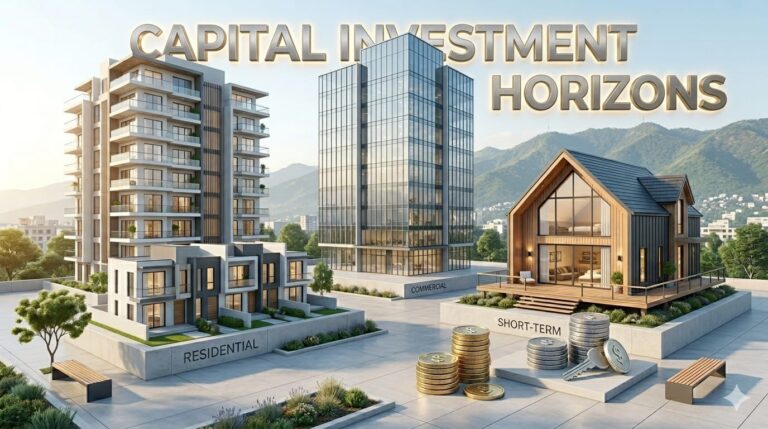
The difference is important because the investment logic is different. Vertical property is often linked with rental yield and convenience. Horizontal property is often linked with land appreciation and long-term growth. One gives earlier use and income, while the other may need patience before the real return appears.
The Case for Vertical Living: Apartments and Mixed-Use Projects
Vertical living is becoming more common in Pakistan’s urban centers. As land becomes expensive in prime areas, apartment living offers a practical solution for families, professionals, students, and overseas Pakistanis who want security, convenience, and access to city facilities.
1. Better Access and Prime Location
Apartments in established locations usually offer easy access to business districts, schools, hospitals, shopping areas, restaurants, offices, and public services. This matters a lot for tenants and end-users because daily convenience is one of the main reasons people choose apartments.
In cities like Islamabad, Lahore, and Karachi, many tenants prefer apartments near main roads, commercial centers, universities, hospitals, and office zones. This makes well-located apartment projects useful for investors who want steady rental demand.
2. Ready Rental Market
One of the biggest strengths of apartment investment is rental income. A good apartment in a strong location can start generating rent soon after possession, especially if the building is well-managed and located near active residential or commercial demand.
This makes vertical property suitable for investors who want monthly cash flow instead of waiting only for capital gain. Rental income can also help cover service charges, maintenance, and part of the holding cost.
3. Lower Management Burden
Compared with a standalone house or undeveloped land, apartments can be easier to manage. Many projects offer security, maintenance staff, lifts, parking, backup systems, and shared facilities. This is useful for overseas Pakistanis or investors who do not want daily management problems.
However, this convenience comes with a cost. Monthly maintenance and service charges must be included in the return calculation. An apartment may show good gross rent, but the net rental yield can be lower after maintenance, vacancy, repairs, and society charges.
4. Better Suitability for Smaller Budgets
In some prime areas, buying a full plot or house may be too expensive. An apartment can give investors access to a good location at a relatively lower entry price. This makes apartments attractive for first-time investors, small families, and buyers who want to enter a mature market without buying expensive land.
Risks of Apartment Investment in Pakistan
Apartments are not risk-free. Investors should avoid treating every high-rise project as a safe investment. The success of an apartment depends on location, builder reputation, construction quality, management quality, parking, utilities, occupancy demand, and resale activity.
Common apartment risks include:
- Delayed possession: Some vertical projects take longer than promised, especially if approvals, financing, or construction management are weak.
- Service charges: Monthly maintenance charges can reduce net rental income.
- Oversupply: If too many similar apartment projects launch in one area, resale and rent growth may slow down.
- Poor building management: Bad maintenance, lift issues, water problems, parking problems, and weak security can reduce demand.
- Resale pressure: If many investors own similar units in the same building, it may become harder to sell quickly.
- Legal and approval risk: Buyers must verify building approval, land title, NOC, layout approval, and transfer process.
For apartments, the building itself matters as much as the location. A good location with poor building management can still become a weak investment.

The Case for Horizontal Expansion: Plots and Land
Pakistan has traditionally been a land-focused market. Many investors prefer plots because land is limited, easy to understand, and usually performs well over the long term in strong locations. Horizontal investment is especially popular in developing housing societies, new phases, suburban corridors, and areas where infrastructure is expanding.
1. Strong Long-Term Capital Appreciation
The biggest attraction of land is capital appreciation. If a buyer enters a developing area early and the society completes roads, utilities, parks, commercial areas, and possession, the value of land can increase significantly over time.
This is why investors often look at emerging suburbs and new societies around major cities. Areas that were once considered far can become valuable when road access improves, population increases, and commercial activity starts.
2. Lower Entry Cost in Developing Areas
Compared with prime city-center property, suburban land is often available at a lower price. This allows investors to buy a larger plot or enter an area before prices mature. For long-term investors, this can be a strong opportunity if the society is legally safe and development is realistic.
3. Flexibility for Future Use
Land gives flexibility. The owner can hold it, resell it, build a house, develop rental units, or use it for future family needs. This flexibility is one reason plots remain attractive for Pakistani families and overseas investors.
4. Lower Maintenance Cost
A plot usually has lower maintenance requirements compared with a house or apartment. There is no tenant handling, building repair, lift maintenance, or interior damage. However, investors should still check society dues, development charges, possession charges, and transfer expenses.

Built Houses Within Horizontal Investment
Houses are part of horizontal investment because they are built on land and belong to the low-rise residential property category. The difference is that a house is not a raw land asset like a plot. It is a completed or usable property that can provide rental income, personal use, and long-term land-backed appreciation at the same time.
A ready house in a strong location can be rented out immediately, used personally, or held for long-term appreciation. The land component can support future value, while the built structure can provide practical use. In many established areas of Islamabad, Rawalpindi, Lahore, and other major cities, houses remain popular because buyers trust land-backed assets.
However, houses also have higher maintenance costs than plots and apartments. Paint, plumbing, electrical work, seepage, repairs, fixtures, and tenant wear-and-tear can reduce net rental return. Before buying a house for investment, investors should compare purchase price, expected rent, repair cost, location demand, and resale liquidity.
Commercial Property: Higher Rent, Higher Due Diligence
Commercial property can be part of both vertical and horizontal investment. Shops, offices, commercial floors, mixed-use units, and commercial plots can offer stronger rental income than residential property in some locations. But commercial investment also needs more careful checking.
A shop or office is only valuable if it has real business demand. Main road access, parking, visibility, footfall, nearby population, tenant profile, and commercial activity matter more than design alone. A beautifully built commercial unit in a weak or inactive location may remain vacant for a long time.
Commercial property can suit investors who want rental income and can handle longer vacancy periods. It should not be bought only because the payment plan looks attractive. The investor should check actual market rent, business activity, resale demand, and whether the project has proper commercial approvals.

Developed Plot vs File: A Critical Difference
In Pakistan, the word “plot” is sometimes used loosely, but investors must understand the difference between a developed plot, non-developed plot, possession plot, and file.
- Developed plot: Roads, streets, utilities, and basic infrastructure are mostly completed. This is generally safer and easier to resell.
- Possession plot: The buyer can physically identify and take possession of the plot. This is usually more secure than non-possession inventory.
- Non-possession plot: The plot is allotted but possession may not be available yet. Its value depends heavily on development progress.
- File: A file may represent future allotment or claim in a society/project. Files can offer high upside but also carry higher risk.
For cautious investors, developed and possession plots are usually safer. For high-risk investors, files and early-stage inventory can offer higher returns, but only if the developer is credible, approvals are clear, and the development plan is realistic.
Risks of Horizontal Expansion
Horizontal expansion can deliver strong returns, but it requires patience and due diligence. A developing area can take years to mature. Investors should not buy only because prices look low.
Major risks include:
- Slow development: Roads, utilities, sewerage, parks, and possession may take longer than expected.
- Legal uncertainty: Some societies or land pockets may face approval, ownership, or boundary issues.
- Speculative pricing: Prices may rise due to hype rather than real development.
- No rental income: Undeveloped plots usually do not generate monthly cash flow.
- Liquidity risk: In a slow market, suburban plots can take longer to sell.
- Extra charges: Development charges, transfer fees, possession charges, and utility charges can affect actual ROI.
Horizontal investment is best for investors who can hold patiently and do not need immediate monthly income.
Rental Yield vs Capital Appreciation
Before choosing between vertical and horizontal investment, investors should understand the difference between rental yield and capital appreciation.
Rental yield is the income you receive from rent compared with the property price. Apartments, houses, shops, and offices can provide rental yield if they are located in active rental markets.
Capital appreciation is the increase in property value over time. Plots and land often depend more on appreciation than rental income.
For example, an apartment in a mature location may give monthly rent and steady appreciation. A plot in a developing society may give no rent for several years but can provide stronger capital gain if the area develops successfully. A house can offer both rent and long-term land-backed value, but it also needs more maintenance.
The right choice depends on your investment need. If you need income, rental property may be better. If you can wait for long-term growth, land may be better.

Liquidity and Exit Strategy
A serious investor should always think about exit strategy before buying. Liquidity means how easily you can sell the property when needed.
A good apartment in a strong rental location may attract buyers because it already has rental demand. But if many similar apartments are available in the same project, resale may become competitive.
A developed plot in a popular society can be liquid if the area has strong buyer demand. But a file or plot in a slow-developing area may take longer to sell, especially during a slow market.
Before buying, ask these questions:
- How many buyers are active in this area?
- How quickly do similar properties sell?
- Is demand coming from genuine end-users or only investors?
- Can the property generate rent if resale slows down?
- What is the realistic holding period?
Buying without an exit plan can trap capital for longer than expected.
Legal Safety and Due Diligence
Legal safety is one of the most important parts of real estate investment in Pakistan. Whether you are buying an apartment, plot, house, shop, or file, documentation must be verified carefully.
For apartments and vertical projects, verify:
- Land ownership and title
- Building approval and layout approval
- NOC or relevant development authority approval where applicable
- Approved floors and construction permissions
- Builder/developer history
- Possession timeline and penalty clauses
- Maintenance and service charge structure
- Parking allocation and utility arrangements
For plots and land, verify:
- Society approval and legal status
- Transfer process
- Allotment or registry documents
- Possession status
- Development charges and pending dues
- Location on map and ground verification
- Nearby development and access roads
- Market resale demand
For houses, verify:
- Ownership documents and transfer status
- Approved building plan, where applicable
- Construction quality and age of the house
- Structural condition, seepage, plumbing, and electrical work
- Utility bills, society dues, and pending charges
- Rental demand and resale comparison in the same area
A low price is not useful if the property is legally weak. Safe documentation should always come before expected profit.

Financing, Installments, and Affordability
Many buyers in Pakistan invest through installment plans, booking amounts, down payments, or staged payments. This can make property investment easier, but it also requires careful planning.
Installment-based apartment projects may look affordable at the start, but the buyer should calculate the full cost, including development charges, possession charges, documentation charges, transfer fees, taxes, and monthly service charges after completion.
Similarly, plot files and society installments can be attractive, but investors must check whether the developer has a strong delivery record. A low booking price is not enough. The project must have legal clarity, development capacity, and realistic timelines.
If bank financing is involved, the buyer must also calculate monthly payments, interest cost, and income stability. A property should not create financial pressure beyond the buyer’s comfort level.
City-Wise Investment Behaviour in Pakistan
Real estate behaviour is not the same in every Pakistani city. The best choice depends on local demand, land availability, population density, rental culture, and infrastructure growth.
Islamabad and Rawalpindi
Islamabad and Rawalpindi offer both vertical and horizontal opportunities. Apartments can work well near commercial areas, main roads, universities, and employment zones. Plots and houses remain strong in established and developing societies where road access, possession, and family demand are clear.
Lahore
Lahore has strong suburban expansion, especially in planned housing societies and developing corridors. Plots and houses remain popular for long-term appreciation, while apartments can perform well in premium pockets with real rental demand and strong project management.
Karachi
Karachi has stronger vertical demand because of population density, limited central land, and rental demand in active urban areas. Apartments and mixed-use projects can be attractive, but buyers must carefully check building quality, approvals, parking, maintenance, and security.
Smaller and Emerging Cities
In many smaller cities, plots and houses are still preferred over apartments because buyers often value land ownership more. Apartment demand may grow over time, but investors should confirm actual rental and resale demand before entering vertical projects in such markets.
Who Should Invest in Apartments?
Apartments may be suitable for investors who want:
- Monthly rental income
- Lower management burden
- Access to prime or central locations
- Security and shared facilities
- A smaller entry ticket compared with a full house or prime plot
- A property that can be used personally or rented out
Apartments can be a good choice for overseas Pakistanis, rental-income investors, smaller-budget buyers, and people who prefer ready or near-ready property. The key is to choose a project with strong occupancy demand, proper approvals, good maintenance, and reasonable pricing.
Who Should Invest in Plots or Land?
Plots and land may be suitable for investors who want:
- Long-term capital appreciation
- Future construction flexibility
- Lower maintenance responsibility
- Exposure to developing areas and future growth corridors
- A land-bank strategy for 3 to 7 years or more
- Potentially higher percentage gains over time
This option is better for investors who can wait patiently and do not need immediate rental income. It is especially suitable when the society is legally approved, development is visible, possession is possible, and demand is increasing gradually.
Who Should Invest in Built Houses?
Houses may be suitable for investors and buyers who want:
- Personal use with long-term investment value
- Rental income from a complete home or portion
- Land-backed value with practical usability
- Better family appeal in established residential areas
- Future renovation, reconstruction, or resale potential
A house can be a balanced horizontal property option, but it needs careful inspection and realistic budgeting. Investors should not ignore repair cost, maintenance, tenant handling, and design age.
Vertical vs Horizontal Investment: Practical Comparison
| Factor | Vertical Investment | Horizontal Investment |
|---|---|---|
| Common Asset Type | Apartments, mixed-use units, shops, offices, commercial floors | Plots, land, houses, farmhouses, society files |
| Main Benefit | Rental income, convenience, and urban access | Long-term capital appreciation and land ownership |
| Entry Cost | Can be lower than buying a full house or prime plot | Varies widely; developing areas may offer lower entry cost |
| Rental Income | Usually possible after possession | Usually none unless built, developed, or rented as a house/commercial unit |
| Holding Period | Short to medium term possible if rental demand is strong | Medium to long term preferred, especially for developing areas |
| Maintenance Cost | Service charges, repairs, and building management costs apply | Usually lower for plots, higher for houses or developed property |
| Development Risk | High if the building is delayed or approvals are unclear | High if society development, possession, or approvals are unclear |
| Liquidity | Good if rental demand and building management are strong | Good in popular societies, weak in slow or speculative areas |
| Best Exit Strategy | Sell with rental history, occupancy demand, or possession advantage | Sell after development progress, possession, road access, or area maturity |
| Best For | Income-focused, convenience-focused, and low-management investors | Capital-gain, land-bank, and long-term investors |
Best Choice by Investment Goal
If Your Goal Is Monthly Income
Choose a ready or near-ready apartment, house, shop, or office in a location with strong tenant demand. Check actual rents, vacancy risk, service charges, and maintenance before buying.
If Your Goal Is Long-Term Capital Gain
Choose a legally safe developed plot or possession plot in a growing society with real infrastructure progress. Avoid buying only on rumors or future promises.
If Your Goal Is Low Management
A well-managed apartment may be better because maintenance and security are handled by the building or project management. This is useful for overseas buyers and busy investors.
If Your Goal Is Future Construction
A plot is usually better because it gives flexibility to build a house, rental portion, commercial unit, or hold for future family use.
If Your Budget Is Limited
Compare small apartments, smaller plot sizes, or installment plans. But do not choose the cheapest option blindly. Legal safety and location demand are more important than low entry price.
Common Mistakes Investors Should Avoid
Many property losses happen because buyers focus only on expected profit and ignore practical risks. Before investing in vertical or horizontal property, avoid these common mistakes:
- Buying only because the price is low: Cheap property is not always good property. Weak location, unclear documents, or slow development can trap capital.
- Ignoring legal approval: Always verify NOC, title, transfer process, possession status, and development authority approval where applicable.
- Ignoring net rental yield: Calculate rent after service charges, maintenance, vacancy, taxes, and repairs.
- Buying files without understanding risk: Files can give high returns, but they are not the same as possession plots.
- Following market hype: Do not buy only because others are buying. Check actual development and resale demand.
- No exit plan: Every investment should have a clear resale or rental strategy.
- Overstretching the budget: Keep room for transfer fees, taxes, installments, development charges, and emergency expenses.
Market Direction: Why Both Models Matter

Pakistan’s cities need both vertical living and horizontal expansion. City centers cannot expand endlessly, so vertical projects help accommodate population growth in mature areas. At the same time, suburban expansion is necessary because families continue to demand plots, houses, and planned communities.
In the coming years, successful investors will not think in simple terms like “apartments are better” or “plots are better.” They will compare location, documentation, rental demand, development progress, pricing, and exit strategy. The best asset is the one that matches the investor’s objective.
Final Verdict: Which Is Better?
There is no single answer. Vertical living and horizontal expansion both have strong investment potential in Pakistan, but they are suitable for different investors.
If you want rental income, convenience, and lower day-to-day management, a well-located apartment or mixed-use property can be a strong choice. It is especially useful in mature areas where tenants are active and services are already available.
If you want long-term capital appreciation and can hold patiently, a legally safe developed plot or possession plot in a growing suburban society may offer better upside. But the risk is higher if the area is undeveloped, the society is unclear, or the investment is based only on speculation.
If you want personal use, rental possibility, and land-backed value, a built house in a strong residential area can be a practical horizontal investment. It may need more maintenance than an apartment or plot, but it can serve both family and investment goals.
The safest approach is to avoid emotional buying. Compare the property with nearby market rates, verify the legal status, calculate all costs, understand rental or resale demand, and decide your holding period before investing.
In Pakistan’s real estate market, profit is not made only by buying early. Profit is made by buying the right property, in the right location, at the right price, with the right documents and a clear exit plan.

Need Help Choosing the Right Investment?
At Manahil Estate, we help buyers and investors compare apartments, plots, houses, commercial units, and developing society options with a practical market approach. Whether your goal is rental income, long-term appreciation, future construction, or safe capital placement, our team can guide you toward options that match your budget and investment plan.
Contact Manahil Estate today for expert consultation and secure property investment guidance in Pakistan.